




The Jewel in Orion's Sword
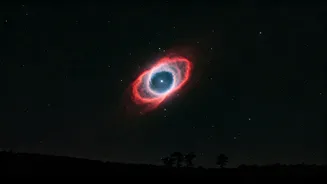
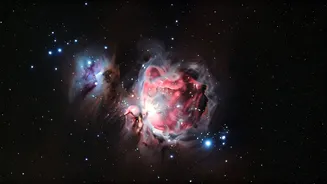
The 'mysterious deep space nebula' you’ve heard whispers about is likely the great Orion Nebula, also known as Messier 42 (M42). Located nearly 1,350 light-years away, it’s the closest large star-forming region to Earth. So, what makes it mysterious?
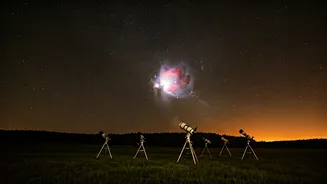
This isn't a cosmic ghost story; it's a story of creation. The Orion Nebula is a stellar nursery, a turbulent cauldron of gas and dust where gravitational forces are pulling material together to forge thousands of new stars and planetary systems. At its heart lies a cluster of hot, young, massive stars known as the Trapezium, whose intense ultraviolet radiation makes the surrounding gas glow, creating the breathtaking spectacle we can see from our own backyards.
How to Find This Cosmic Nursery
Finding the Orion Nebula is one of the most rewarding first steps for any budding stargazer. You don’t need a map of the galaxy, just a clear view of the winter sky (from November to March is ideal in India). First, locate the constellation of Orion, easily identifiable by the three bright stars in a straight line that form his 'belt'. From there, look just below the belt for another, fainter line of stars—this is Orion's sword. The nebula isn't a star, but a fuzzy, misty patch in the middle of this sword. To the naked eye in a dark location, it will look like a faint, out-of-place cloud. This subtle smudge is your first glimpse of a star factory in action.
From Naked Eye to Telescope
The beauty of the Orion Nebula is that it rewards every level of observation. Your own eyes are enough to confirm its location. But the real magic begins when you introduce even the simplest optical aid. A pair of basic binoculars will transform the fuzzy patch into a distinct, glowing cloud, and you might even be able to pick out the four main stars of the Trapezium cluster within it. It’s a stunning sight. If you have access to a small amateur telescope, the view becomes even more spectacular. You’ll see intricate tendrils of gas and dust, subtle variations in brightness, and the deep, three-dimensional structure of the cloud. The nebula goes from being a point of interest to a whole world to explore.
Why You Shouldn't Stargaze Alone
This is where astronomy clubs come in. While you can certainly start this journey on your own, joining a local club elevates the experience from a solitary hobby to a shared adventure. Clubs across India, from the Bangalore Astronomical Society to the Amateur Astronomers Association in Delhi and countless others in cities like Mumbai, Pune, and Kolkata, are treasure troves of knowledge. They are communities of passionate amateurs and seasoned experts who love nothing more than to share their passion—and their telescopes—with newcomers. These clubs demystify the cosmos, turning a confusing sky into a familiar neighbourhood.
Finding Your Local Star Crew
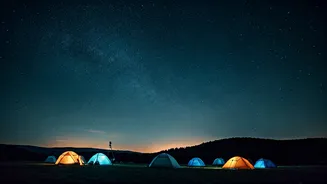
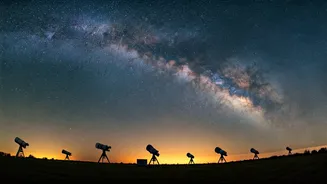
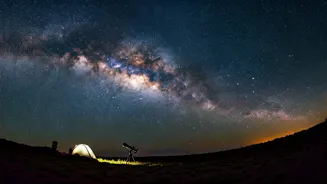
Joining a club is easier than you think. A simple online search for “astronomy club near me” is a great starting point. Many cities have active Facebook groups or websites dedicated to amateur astronomy. Local planetariums, like the various Nehru Planetariums, and science centres are also excellent resources; they often host public viewing events or are connected to the local club scene. These clubs regularly organise 'star parties' at dark-sky locations away from city lights. At these events, members set up their telescopes, and everyone is invited to look. It’s the perfect opportunity to see the Orion Nebula through a powerful instrument and ask every question you can think of. They provide the gear, the guidance, and the community—all you need to bring is your curiosity.