

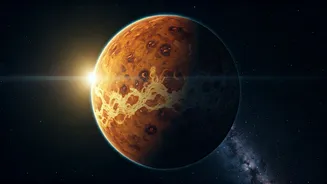



A Journey to the Inferno
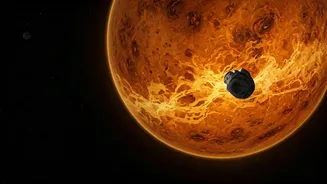
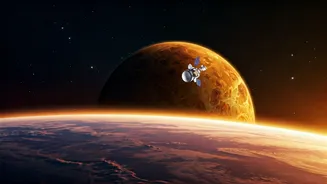
India is setting its sights on one of the most inhospitable destinations in the solar system: Venus. The Indian Space Research Organisation's (ISRO) Venus Orbiter Mission, named Shukrayaan-1, received formal government approval in September 2024 and is slated
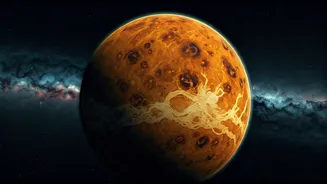
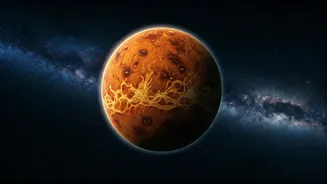
for a March 2028 launch. This ambitious project marks India's first journey to our nearest planetary neighbour and its third venture into interplanetary space, following the successes of its Mars and Moon missions. Venus, often called Earth's twin due to its similar size and density, is a world of extremes. Its surface is scorched by temperatures hot enough to melt lead, and the atmospheric pressure is over 90 times that of Earth's. The planet is perpetually shrouded in thick clouds of sulphuric acid, making its surface impossible to observe in visible light. Shukrayaan-1 aims to peer through this veil to understand the planet's mysterious past and what it can teach us about our own future.
Venus: A Tale of Two Planets
The story of Venus is a cautionary one. Scientists believe that billions of years ago, Venus may have been much more like Earth, possibly hosting vast liquid water oceans. However, being closer to the Sun, the planet began to trap too much heat. This triggered a catastrophic feedback loop: as the oceans evaporated, the water vapour in the atmosphere—a potent greenhouse gas—trapped even more heat, causing more water to evaporate. This process, known as a runaway greenhouse effect, ultimately boiled away Venus's oceans and transformed the planet into the inferno we see today. Its atmosphere is now composed almost entirely of carbon dioxide, the densest in the solar system. By studying Venus, scientists have a natural laboratory to understand how a habitable world can be pushed past a climatic tipping point.
Science from Orbit
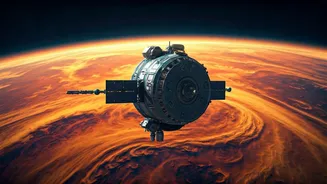
The Shukrayaan-1 orbiter, launched aboard a powerful LVM-3 rocket, will carry a sophisticated suite of instruments to conduct a comprehensive study of Venus. One of its primary tools will be a high-resolution Synthetic Aperture Radar (SAR), which can penetrate the dense cloud cover to map the planet's surface in unprecedented detail, searching for signs of active volcanoes and other geological features. Another groundbreaking instrument is a ground-penetrating radar, which would make it the first mission ever to study the planet's sub-surface. The mission will also carry payloads developed in collaboration with international partners, including instruments from Sweden and Russia-France, to study the chemistry of the atmosphere and its interaction with the solar wind. The key scientific objectives include investigating the planet’s atmospheric dynamics, its chemical composition, and the processes that led to its extreme climate.
A Global Climate Change Laboratory
The true significance of Shukrayaan-1 extends far beyond Venus. It is fundamentally about understanding the mechanics of climate change. By studying a planet that has experienced a runaway greenhouse effect, scientists can refine the climate models they use to predict Earth's future. Testing these models against the extreme conditions on Venus helps validate their accuracy and provides crucial data on how atmospheric systems behave under intense pressure from greenhouse gases. While Earth is not in immediate danger of becoming another Venus, the lessons are stark. Venus provides a vivid example of how a planet's climate can be irrevocably altered. The data gathered by Shukrayaan-1 will contribute to a global effort to understand planetary habitability, informing not just our view of the solar system, but also our approach to managing Earth's delicate climate balance. This Indian-led mission joins a new wave of Venus exploration, alongside missions planned by NASA and the European Space Agency, promising a golden era of discovery for Earth's often-overlooked twin.