




Often overlooked, the standing torso twist is a simple yet potent exercise for your core and spine. While the movement seems basic, the secret to unlocking its full potential lies in one key detail: your breath. Let's break it down.
Why Add This Twist to Your Routine?
Before we get into
the 'how', let's cover the 'why'. The standing torso twist is more than just a simple warm-up movement. It's a foundational exercise that targets key muscles and offers a range of benefits. Primarily, it engages your obliques, the muscles running along the sides of your abdomen, which are crucial for rotational strength and a stable core. A strong core is vital for almost every daily movement, from lifting groceries to maintaining good posture at your desk. This exercise also promotes spinal mobility, particularly in the thoracic spine (your mid-back). By gently twisting, you help decompress the vertebrae and can alleviate stiffness caused by prolonged sitting. This improved flexibility and range of motion can translate to better performance in sports and a reduced risk of back strain during everyday activities.
Your Step-by-Step Form Guide
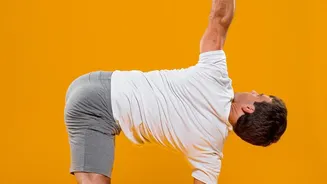
Proper form is everything. Rushing the movement or using momentum will rob you of the benefits and could even lead to strain. Follow these steps for a safe and effective twist: 1. Stand tall with your feet shoulder-width or hip-width apart and a slight bend in your knees. This stable base is your foundation. 2. Engage your core by gently bracing your abdominal muscles, as if you're about to be punched in the stomach. This protects your lower back. 3. There are a few arm variations. For beginners, crossing your arms over your chest or placing your hands on your hips is a great start. You can also bend your arms at a 90-degree angle at your sides. 4. Initiate the twist from your torso, not your arms or hips. Rotate your upper body smoothly to one side. A key point is to try to keep your hips facing forward as much as possible. The movement should come from your mid-back. 5. Rotate only as far as is comfortable. Don't force the twist. 6. Pause briefly at the end of the rotation, then slowly and with control, return to the center. Repeat on the other side.
The Secret: Syncing Breath with Movement
Here is where the magic happens. Your breath dictates the pace and effectiveness of the exercise. Many people instinctively hold their breath during the twisting motion, which creates unnecessary tension. Instead, you should sync your breath with the movement to deepen the stretch and engage your core more effectively. The correct pattern is simple: exhale as you twist, and inhale as you return to the center. The exhalation helps to naturally contract your abdominal muscles, deepening the engagement of your obliques as you rotate. The inhalation on the return to the starting position helps to lengthen your spine, preparing you for the next twist. This deliberate breathing keeps the movement controlled and mindful, transforming it from a simple swing into a targeted core exercise. It also improves your body's overall breathing mechanics.
Common Mistakes to Avoid
To get the most out of your twists, watch out for these common errors: - Using Momentum: One of the biggest mistakes is whipping your body from side to side. The goal is controlled muscular effort, not speed. Slow it down. - Moving Your Hips: If your hips and lower body are rotating along with your shoulders, you're not isolating your core. The idea is to create separation between your stable lower body and your rotating upper body. Keep those hips pointed forward. - Forcing the Range of Motion: Pushing past a comfortable range can strain the muscles in your back. Twist until you feel a gentle stretch, not pain. - Hunching Your Back: Keep your spine long and your posture tall throughout the exercise. Slouching can put undue pressure on your lower back and disengages the core.
Ways to Progress and Vary the Twist
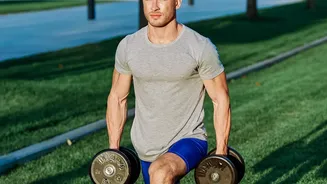
Once you've mastered the basic form, you can add challenge and variety. For a simple progression, hold a light dumbbell or a medicine ball with both hands, extending your arms straight out from your chest. As you twist, the weight adds resistance, forcing your obliques to work harder. Another excellent variation involves using a resistance band. Anchor the band at chest height to a stable object. Stand sideways to the anchor point, grab the band with both hands, and step away to create tension. With your arms extended, rotate your torso away from the anchor point, fighting the pull of the band. This is a fantastic way to build rotational power.