



The idea of giant cargo ships navigating the oceans without a human crew sounds like science fiction. But researchers at IIT Madras are bringing it closer to reality with SeaNav, a breakthrough platform for safely testing and training self-driving ships.
What is SeaNav?
SeaNav, short for Sea Navigation, is a state-of-the-art virtual testing ground. It is not the self-driving system itself, but rather a sophisticated simulator where these autonomous systems can be developed, validated, and perfected. Developed by the Department of Ocean Engineering at IIT Madras, it addresses one of the biggest hurdles in maritime autonomy: the danger and expense of real-world testing. Trying out new navigation algorithms on a multi-million dollar vessel in a busy shipping lane is fraught with risk. SeaNav eliminates this by creating a realistic, high-fidelity virtual maritime environment. It allows developers to simulate everything from the ship's own movement to complex ocean conditions and vessel traffic, all in real-time.
A Digital Twin on the Water
The core of SeaNav's technology is the concept of a 'digital twin'. Built on the powerful Unity3D engine, the platform creates a virtual replica of the maritime world, complete with accurate models for ocean waves and vessel movements. Researchers can test their AI-driven navigation software on this digital twin, pushing it to its limits in a variety of scenarios without any physical risk. To ensure the simulations are true to life, the system has been calibrated using a benchmark model of a 320-meter-long tanker, allowing virtual results to closely mirror real-world performance. This combination of digital twins, AI, sensor fusion, and virtual reality creates a safe and efficient training ground for both autonomous systems and their human supervisors before they are deployed at sea.
Why This is a Game-Changer for India
With over 80% of global trade moving by sea, the stakes for maritime innovation are enormous. The development of SeaNav aligns perfectly with national initiatives like the 'Sagarmala Programme' and Maritime India Vision 2030, which call for the adoption of digital technologies to create smart ports and autonomous systems. By enabling the indigenous development of autonomous technology, IIT Madras is positioning India to become a leader in a field currently dominated by a few other nations. The benefits are clear: smarter navigation can reduce fuel consumption, lower carbon emissions, and drastically minimise the risk of human error, which is a factor in many maritime accidents like collisions and oil spills. Furthermore, the technology has direct applications for coastal surveillance, search-and rescue operations, and maritime defence.
From Simulation to the Real World
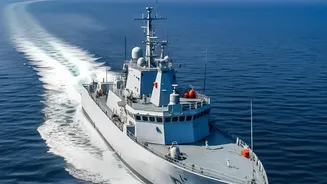
The journey from a successful simulation to a fully autonomous ship is long, but IIT Madras has a clear path forward. The Marine Autonomous Vehicles (MAV) Laboratory is already building and testing a fleet of scaled down ship models, including container ships and destroyers, on the IIT Madras lake. These free running models are equipped with sensors and onboard computers to validate algorithms developed in the simulator. According to Dr. Suresh Rajendran, an Associate Professor in the Department of Ocean Engineering, the platform can be used to strengthen safety at major Indian ports like Chennai, Mumbai, and Kochi by helping develop AI assisted navigation systems that reduce the risk of collisions and groundings. This practical, phased approach—moving from simulation to scaled models to eventual real world application—is crucial for building robust and reliable autonomous vessels.
The SeaNav platform is part of a much larger push by IIT Madras to become a global hub for maritime technology. Its 'Discovery Campus' is home to a suite of advanced facilities, including a Circulating Water Tunnel for hydrodynamic testing, developed in partnership with Mazagon Dock Shipbuilders Limited. This ecosystem fosters innovation in everything from ship design to offshore renewable energy. The ultimate goal is to reduce India's reliance on foreign expertise and technology in the maritime sector, a key objective of the 'Aatmanirbhar Bharat' initiative. By developing not just the technology but also the trained manpower, institutions like IIT Madras are charting a new, self -reliant course for India's massive maritime industry.