




The Life and Death of a Star
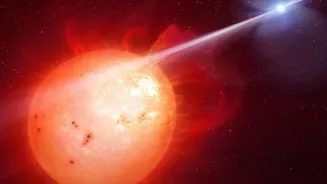
Most stars, including our own Sun, have a predictable life cycle. They spend billions of years fusing hydrogen into helium. When that fuel runs out, they swell into massive red giants before shedding their outer layers. What's left behind is a small,
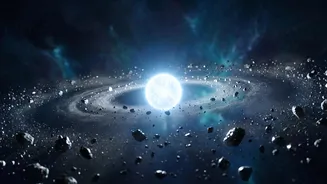
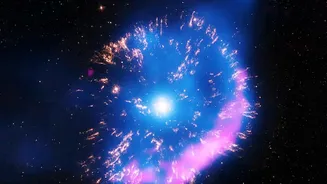
incredibly dense, and hot core called a white dwarf. This stellar remnant is essentially the ghost of a star, slowly cooling over billions of years. Our Sun is expected to meet this fate, and when it does, it will likely engulf Mercury, Venus, and possibly Earth. For a long time, this violent end was seen as the final chapter for a solar system. But a recent discovery challenges that assumption, suggesting new worlds can rise from the remnants.
A Faint Signal and a Chemical Puzzle
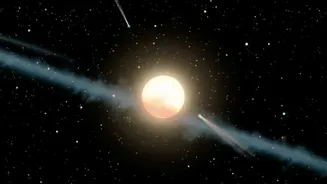
Researchers focusing on a white dwarf named HS 0209+0832, located about 270 light-years away, found two key pieces of evidence. First, data from NASA's Transiting Exoplanet Survey Satellite (TESS) revealed a faint, repeating dip in the star's brightness every 4.4 days. This consistent dimming is a classic sign of an orbiting body, possibly a Jupiter-sized planet, periodically passing in front of the star. But the more compelling clue came from the white dwarf's atmosphere. By analysing old data from the Hubble Space Telescope, astronomers found it was 'polluted' with unusual elements, most notably high amounts of niobium. This element is forged late in a star's life, meaning it shouldn't be part of a typical, 'first-generation' planet that formed with the star.
What is a 'Second-Generation' Planet?
Our Earth and all the other planets in our solar system are first-generation planets. They formed from the same disc of gas and dust that created the Sun. A 'second-generation' planet is a world born from the ashes of a dead star. The theory is that after a star like our Sun becomes a white dwarf, the material it cast off could, under the right conditions, form a new disc of debris. Over millions of years, this material can coalesce to form entirely new planets. These 'phoenix' worlds are incredibly rare, and until now, were mostly hypothesised to exist around different stellar remnants called pulsars, not white dwarfs. The candidate around HS 0209+0832 is the first of its kind to be found orbiting a white dwarf, making it a potentially groundbreaking discovery.
A Glimpse into Our Solar System’s Future?
This discovery isn't just a distant cosmic curiosity; it offers a potential preview of our own solar system's very distant future. The finding raises the question of whether our own Sun could one day host a second generation of planets formed from its own remains. While the candidate around HS 0209+0832 is a gas giant currently being blasted by its hot star's radiation, researchers believe the system will eventually stabilise. As the white dwarf cools, it creates a stable habitable zone for billions of years, far longer than Earth's has been. This suggests that even after a star dies, its system could one day host worlds capable of supporting life. The discovery transforms the end of a star's life from an epilogue into the potential beginning of a new chapter.