




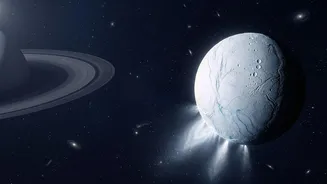


A World of Icy Promise
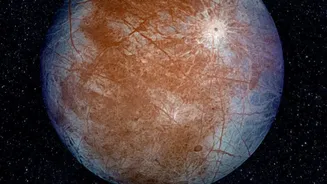
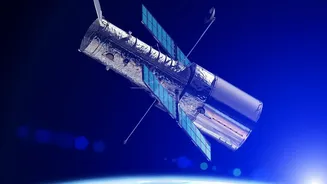
For decades, scientists have gathered tantalizing clues about Europa. Data from missions like Galileo and Voyager, combined with observations from the Hubble Space Telescope, point to a global ocean of liquid saltwater that may contain more than twice
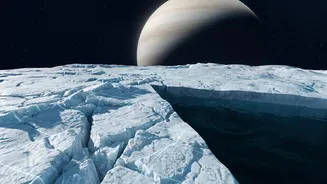
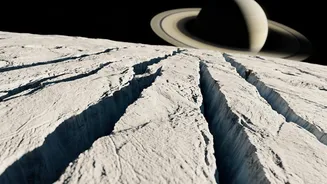
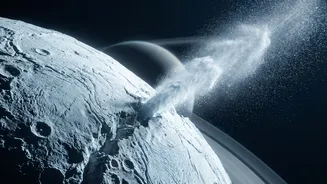
the water of all of Earth's oceans combined. This evidence includes a mysterious induced magnetic field within Europa, which suggests the presence of a conductive material like a salty ocean. The moon's fractured, relatively young surface also hints that the ice shell is not static but is actively interacting with a liquid layer below. The core ingredients for life as we know it—water, chemistry, and energy—could all be present, making Europa a top priority for exploration.
The Europa Clipper Mission
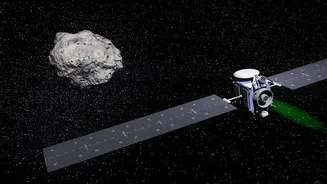
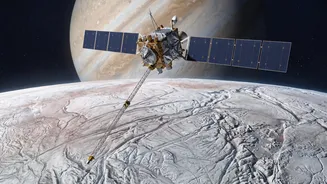
Launched in October 2024, NASA's Europa Clipper spacecraft is undertaking a multi-year journey to the Jupiter system, set to arrive in April 2030. It's not a lander or an orbiter in the traditional sense. Instead, the probe will enter a long, looping orbit around Jupiter and perform dozens of close flybys of Europa, some as low as 25 kilometers above the surface. This strategy allows the spacecraft to gather detailed measurements while minimizing its exposure to Jupiter's intense radiation belts. A suite of nine advanced science instruments will work together to investigate Europa's habitability by studying its ice shell, geology, and composition. But to directly confirm and characterize the ocean, one instrument is uniquely equipped for the job.
Introducing the REASON Instrument
The key to peering beneath the ice is an instrument called REASON, which stands for Radar for Europa Assessment and Sounding: Ocean to Near-surface. While other instruments will study the surface and analyze particles, REASON is the only one designed to look directly through the moon's thick crust of ice. Developed by researchers with experience using similar technology to study Antarctica's ice sheets, this sophisticated radar system is designed to provide the first direct look at the structure of Europa's ice shell. It acts as the mission's high-tech geological surveyor, aiming to finally answer the question of whether an ocean truly lies beneath.
How the Radar Sees Through Ice
REASON works by sending out radio waves from its antennas at two different frequencies: a high frequency (HF) and a very high frequency (VHF). These radio waves are chosen specifically because they can penetrate ice but will bounce off materials with different properties, like liquid water or embedded salts. As the Europa Clipper flies by, REASON will transmit these radio pulses downward. When the signals encounter a boundary—such as the bottom of the ice shell where it meets the ocean, or a pocket of liquid water trapped within the ice—they reflect back to the spacecraft. By measuring the time it takes for these echoes to return, scientists can calculate the depth of the features. The strength of the returning signal provides clues about the nature of the material it bounced off of.
More Than Just Finding an Ocean
Confirming the ocean's existence and measuring its depth is REASON's primary goal, but its capabilities go much further. The instrument is designed to penetrate ice up to 30 kilometers thick, allowing it to create a 3D map of the ice shell's structure. This could reveal pockets of water suspended within the shell, which could be crucial zones for chemical exchange between the surface and the ocean below—a process vital for sustaining a habitable environment. Furthermore, REASON will measure the thickness of the ice shell across the globe, helping scientists understand how it flexes under Jupiter's immense tidal forces. It will also map the surface topography, searching for connections between surface features like ridges and the subsurface structures it discovers.