






From Radio Waves to Light Beams
For decades, communicating with spacecraft meant relying on radio waves. Think of it as the original wireless technology of the cosmos. While reliable, radio frequency (RF) communication is facing a bottleneck. As our scientific instruments become more
advanced, capturing stunning high-resolution images and vast amounts of data, the radio spectrum is getting crowded and the transmission speeds are too slow. It's like trying to download a 4K movie on an old dial-up connection. The solution? Switching from radio waves to light itself. By using invisible infrared lasers, a technology known as optical communications, space agencies can now send and receive data at rates that are 10 to 100 times faster than the best RF systems. This leap is akin to moving from old copper telephone lines to modern fibre-optic internet.
How Does It Actually Work?
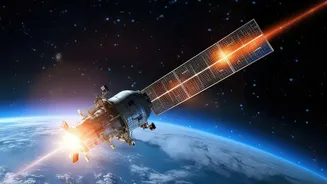
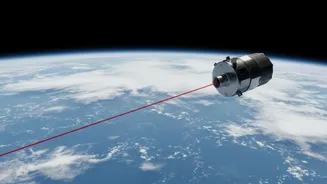
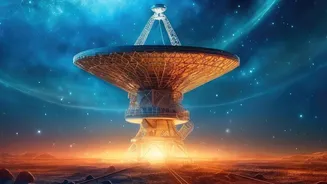
The principle is surprisingly straightforward. Data—whether it's a command for a spacecraft, scientific telemetry, or a high-definition video—is encoded into pulses of light. A flight laser transceiver aboard a spacecraft essentially acts as a high-tech Morse code operator, flashing these encoded light pulses through a telescope towards Earth. On the ground, massive telescopes at specialised optical stations act as receivers. These telescopes collect the photons—the particles of light—and sensitive detectors decode the pulses back into the original data. While both radio and infrared light travel at the same speed, the higher frequency of infrared light allows it to carry significantly more information in each transmission, packing data into much tighter waves.
NASA's DSOC: A Groundbreaking Demonstration
This isn't just theory; it's already happening. NASA's Deep Space Optical Communications (DSOC) experiment is a trailblazing demonstration of this technology. Launched aboard the Psyche spacecraft in October 2023, the DSOC system was designed to test laser communications far beyond the Earth-Moon system. In a historic test, DSOC successfully streamed an ultra-high-definition video of a cat named Taters from 19 million miles away, achieving a data rate faster than many home broadband connections. The two-year demonstration, which concluded in late 2025, consistently shattered records, proving the technology's readiness for future missions by establishing stable links from hundreds of millions of miles away.
The Challenge of Hitting a Moving Target
Transmitting data via laser across the solar system is an incredible feat of precision. The laser beams are extremely narrow, which enhances security but also makes aiming a huge challenge. It requires pointing a laser from a speeding spacecraft and hitting a receiver telescope on a rotating Earth millions of miles away. This is comparable to hitting a moving coin from several kilometres away. Furthermore, Earth's atmosphere presents a significant hurdle. Clouds, rain, and even atmospheric turbulence can scatter or block the laser signal, causing dropouts. To overcome this, space agencies are building a network of optical ground stations in high-altitude, remote locations known for clear weather, ensuring that if one station is clouded over, another can pick up the signal.
A New Era of Space Exploration
The successful demonstration of optical communications marks a pivotal moment for space exploration. The dramatically higher bandwidth will allow us to receive unprecedented volumes of scientific data from probes across the solar system. Instead of waiting weeks for a map of Mars, we could get it in days. For future human missions to the Moon and Mars, this technology is a game-changer. It means reliable, high-definition video links with astronauts, faster transmission of critical mission data, and a more connected human presence in deep space. Laser communications won't entirely replace radio—RF is still excellent for many tasks and less affected by weather—but it provides a powerful, high-speed lane on the interplanetary information highway.