






A New Shape in the Southern Sky
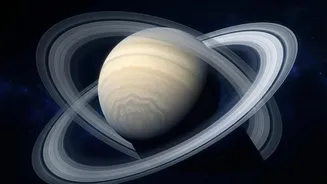
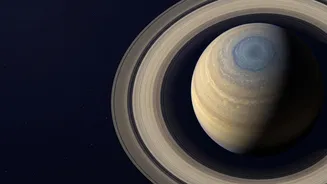
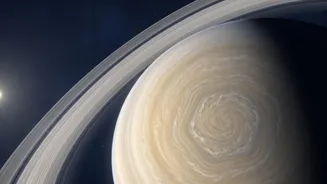
For the first time, astronomers have confirmed a massive, evolving, ten-sided atmospheric wave, or 'decagon', encircling Saturn's south pole. The discovery was made using the Hubble Space Telescope as part of its Outer Planet Atmospheres Legacy (OPAL)
program, which annually captures images of our solar system's gas giants to track long-term changes. This strange new feature is vast, spanning roughly 104,000 miles across, with each of its ten sides measuring about 10,000 miles in length. Unlike a drawing on a canvas, this pattern is a dynamic wave within Saturn's powerful jet stream. Scientists were able to piece together several years of Hubble observations, finding faint hints of the structure emerging in 2023 before it developed into a more clearly defined pattern.
A Tale of Two Poles
This discovery immediately invites comparison to Saturn's other famous polar feature: the bizarre, long-lived hexagon at its north pole. That six-sided jet stream has been observed for over 40 years, first spotted by the Voyager mission in the 1980s. For decades, scientists have wondered if a similar shape existed at the opposite pole. The Cassini spacecraft, which orbited Saturn from 2004 to 2017, saw a powerful cyclone at the south pole but no persistent polygon. The new decagon's recent formation makes it distinctly different. While the northern hexagon has been a stable fixture, this southern ten-sided pattern appears to be a new phenomenon that is actively strengthening, giving scientists a rare chance to watch a giant atmospheric storm develop in real time.
The Science of Planetary Polygons
So, how does a planet's atmosphere form such stunningly geometric shapes? These patterns are not solid structures but are thought to be standing waves locked within powerful jet streams that encircle the poles. In a way, they are giant, organized storms. Laboratory experiments using spinning tanks of fluid have been able to replicate similar polygonal shapes, suggesting they arise from instabilities in the flow of the atmosphere. The shape that forms—be it a hexagon, a decagon, or another polygon—likely depends on the specific speed and properties of the winds. Hubble's observations also show that the decagon is not just a surface-level cloud feature; it's a deep, vertically extended structure that persists through multiple layers of Saturn's atmosphere.
Why This Discovery Matters
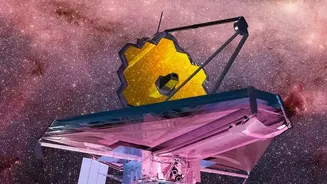
The emergence of the southern decagon is a significant event for planetary science. It demonstrates that Saturn's atmosphere is more dynamic and changeable than previously thought. The fact that it formed so recently, while its northern counterpart has existed for decades, raises compelling questions about the forces that drive these massive atmospheric phenomena. The discovery was a collaborative effort, with hints of the structure first spotted in 2024 by amateur astronomers contributing images to ground-based observatories before being confirmed by Hubble's superior resolution. This new puzzle highlights why long-term monitoring programs like OPAL are crucial. They provide a consistent, year-after-year portrait of these distant worlds, allowing scientists to spot changes that would otherwise be missed. Researchers now plan to use both Hubble and the James Webb Space Telescope to continue studying the decagon, hoping to understand how it formed, how long it might last, and what it can teach us about the complex physics governing the atmospheres of gas giants.