





A New Polygon In the Solar System
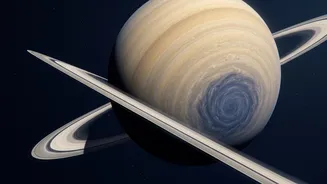
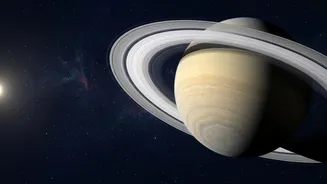
In one of the most surprising astronomical finds in recent years, scientists have confirmed the existence of a massive, 10-sided cloud pattern swirling around Saturn’s south pole. Announced in early September 2026, the discovery was made using data from
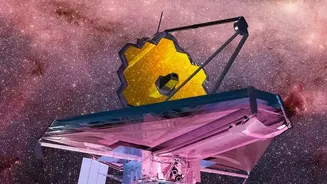
the Hubble Space Telescope, which captured stunning images of the feature. This newfound “decagon” is an enormous atmospheric wave within one of the planet's powerful jet streams. Unlike its famous northern counterpart, this southern polygon appears to be a recent development. Researchers, analyzing archival Hubble images from the Outer Planet Atmospheres Legacy (OPAL) program, found faint traces of the structure emerging in 2023 before developing into the clearer 10-sided pattern seen today. This gives scientists a rare opportunity to watch a giant atmospheric pattern form in near real-time.
A Tale of Two Polygons
For over 40 years, Saturn’s north pole has been home to a famously persistent hexagonal storm, first spotted by the Voyager spacecraft in the early 1980s. This six-sided jet stream is so large that four Earths could fit inside it. Scientists had long wondered if a similar feature existed at the south pole. During its 13-year mission (2004-2017), NASA’s Cassini spacecraft orbited Saturn and found a hurricane-like vortex at the south pole, but no stable, geometric shape like the northern hexagon. The sudden appearance of the decagon has completely changed that picture. It suggests the northern hexagon isn’t a unique fluke, but that the conditions in Saturn’s atmosphere may naturally favor the formation of these bizarre, symmetrical storms in both hemispheres. However, the two are not identical. The northern hexagon has been remarkably stable for decades, whereas the southern decagon seems to be a new and evolving feature.
A Game of Planetary Hide-and-Seek
So why are we only seeing this now? The answer lies in Saturn’s long, slow journey around the sun. With an orbit of about 29 Earth-years and an axial tilt of 27 degrees, Saturn experiences long seasons, each lasting more than seven years. For a long stretch between 2012 and 2023, the planet's southern hemisphere was tilted away from Earth, effectively hiding the south pole from our view. As Saturn’s orbit brought the pole back into sight, astronomers began to notice something strange. Initial hints came from ground-based observatories and a network of amateur astronomers who spotted a faint, wavy band in 2024. To get a clearer look, researchers turned to the Hubble Space Telescope. Its position in space, free from the blurring effects of Earth’s atmosphere, allowed it to confirm the 10-sided structure and track its development.
The Mystery of Planetary Geometry
These polygons are not solid structures but are thought to be waves within powerful jet streams, similar to the jet streams that influence weather on Earth. Scientists believe they form due to the way atmospheric gases move at different speeds. In laboratory experiments, researchers have been able to create similar six-, seven-, and eight-sided shapes by rotating a circular tank of liquid at varying speeds. These experiments suggest that a steep gradient in wind speeds can cause a meandering jet stream to settle into a stable, polygonal shape. The discovery of a second, different polygon on the same planet provides a vital new piece of the puzzle. It allows scientists to compare the conditions that create a hexagon versus a decagon, helping them refine their models of atmospheric dynamics on giant planets throughout the universe.