


Euclid's Groundbreaking Discovery
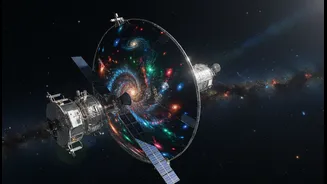
The Euclid space telescope, launched in 2023, has a primary mission to map the dark universe. But in the process of scanning a huge portion of the sky, it has become a revolutionary tool for finding some of the cosmos's most elusive objects. Recently,
astronomers announced that Euclid has identified 31 previously unknown quasars from the very early universe. This is a landmark achievement, as it more than doubles the number of known quasars from this primordial era. Two of these objects have set a new record, being the most ancient quasars ever detected. The light from them began its journey to us when the universe was only about 670 million years old, a mere 5% of its current age.
What Exactly is a Quasar?
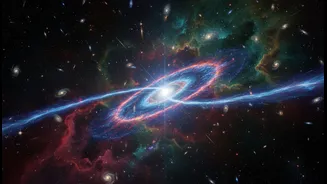
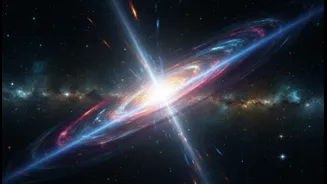
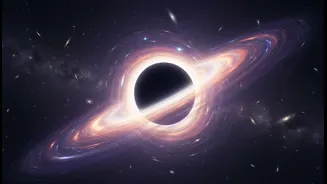
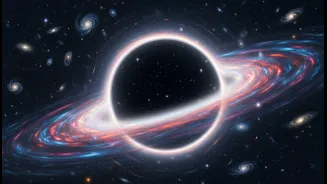
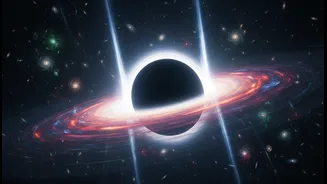
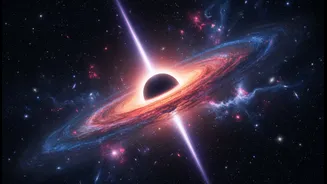
The term 'giant black hole' in the headline refers to a quasar, one of the most luminous and energetic objects known. A quasar is not the black hole itself, but the intensely bright core of a young galaxy. At the center of this galaxy lies a supermassive black hole, millions or even billions of times the mass of our Sun. As this behemoth pulls in surrounding gas and dust, the material forms a spinning disk around it called an accretion disk. The immense gravitational and frictional forces heat this disk to millions of degrees, causing it to glow with the light of a trillion suns, often outshining the entire host galaxy. This brilliant beacon of light is what we detect as a quasar.
The Mystery of 'Too Big, Too Soon'
The discovery of these ancient quasars deepens a long-standing cosmic puzzle for astrophysicists: how did supermassive black holes get so enormous, so quickly? According to our current understanding of the cosmos, black holes grow over time by consuming matter or merging with other black holes. However, for these black holes to have reached millions of solar masses in just a few hundred million years after the Big Bang is a serious challenge to existing models. It's like finding a six-foot-tall toddler; it simply shouldn't have had enough time to grow that big. This suggests that the 'seeds' from which these black holes grew may have been much larger than previously thought, perhaps forming from the direct collapse of massive gas clouds rather than from the remnants of single stars.
Why Euclid is a Game-Changer
Before Euclid, searching for these distant quasars was a painstaking process, often relying on ground-based telescopes and yielding only a handful of the brightest examples over many years. Euclid's advantage is its ability to scan vast areas of the sky with high sensitivity in the near-infrared spectrum. This allows it to spot fainter, more typical quasars from the early universe, not just the exceptionally bright outliers. While a Hubble image might be just as sharp, Euclid's field of view is 270 times larger, allowing it to survey the sky far more efficiently. By finding a larger population of these objects, scientists can move from studying rare exceptions to understanding the general behaviour of the first black holes and galaxies.
What This Means for Our Cosmic Story
Each new quasar discovered from this era, known as the 'epoch of reionization', is a data point that helps reconstruct the story of the early universe. These objects provide crucial information about how the first stars and galaxies formed, ending the cosmic 'dark ages' that followed the Big Bang. The larger sample of ancient quasars provided by Euclid will allow astronomers to test and refine their theories on black hole formation. It also helps them probe the invisible structures of dark matter that are thought to provide the scaffolding for galaxies to form in the first place. These discoveries are not just about breaking records; they are about filling in the first, and most mysterious, chapter of our universe's history.