




Cosmic Rule-Breakers
When astronomers talk about 'extreme exoplanets', they mean worlds whose properties push the boundaries of what we thought was possible. These planets break the rules we wrote based on our own solar system. They might be extreme in temperature, like the scorching
KELT-9b, which is so hot it's literally vaporizing its own atmosphere. Or they could be extreme in their orbit, density, or environment. By studying these outliers, scientists can stress-test their fundamental models of how planets form and evolve. Each extreme world provides a unique data point that either confirms a theory or, more excitingly, sends researchers back to the drawing board to figure out what they missed.
The 'Hot Jupiter' Puzzle
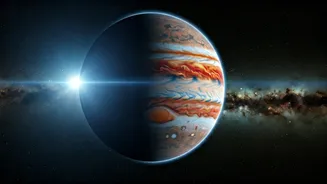
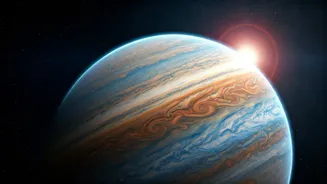
One of the first major puzzles in exoplanet science came from 'hot Jupiters'. These are gas giants, similar in size to our own Jupiter, but they orbit their stars in a matter of days, placing them incredibly close to the stellar furnace. According to early theories of planet formation, giant planets shouldn't be able to form that close to a star. There simply isn't enough material, and the heat is too intense. The discovery of so many hot Jupiters forced a major rethink, leading to the development of 'planetary migration' theories, which propose that these giants form farther out in the cold depths of their solar systems and then spiral inward over time. However, recent discoveries of systems where hot Jupiters coexist with smaller planets are challenging even these revised models, suggesting some may form 'in-situ' close to their star after all.
Laboratories of Fire and Fury
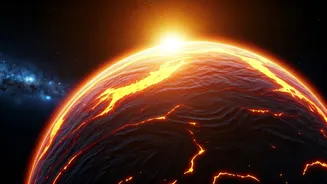
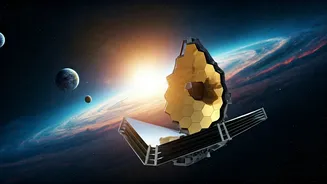
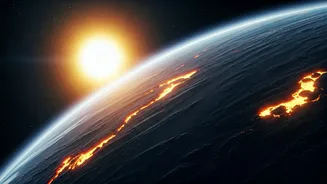
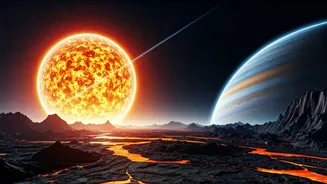
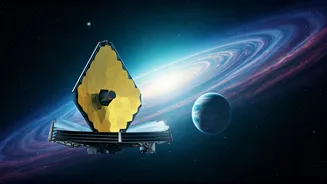
Beyond gas giants, scientists are fascinated by extreme rocky worlds. Take 55 Cancri e, a 'super-Earth' twice the size of our planet that orbits its star in just 18 hours. Its surface is likely a molten ocean of lava with temperatures soaring over 1,700 degrees Celsius. For a long time, scientists debated whether a planet this hot could even hold onto an atmosphere. But recent observations from the James Webb Space Telescope suggest it has a substantial secondary atmosphere, likely composed of carbon monoxide and carbon dioxide, that is constantly being replenished by gases bubbling out of the magma ocean. Studying this process gives scientists a real-world look at the extreme geology and atmosphere-surface interactions that may have occurred on planets like Earth in their fiery infancy.
Planets Around Stellar Corpses
Perhaps the most extreme environments are found around pulsars—the super-dense, rapidly spinning remnants of massive stars that have gone supernova. In fact, the very first exoplanets ever confirmed were discovered in 1992 orbiting a pulsar called PSR B1257+12. This discovery was shocking because a supernova was thought to be a cataclysmic event that would destroy any existing planets. The existence of these 'pulsar planets' proves that planetary systems can form even in the chaotic aftermath of a star's death, perhaps from the debris left over from the explosion or from the vaporized remains of a former companion star. Though these worlds are rare and bathed in intense radiation, they show that the drive to form planets is more resilient than anyone ever imagined.