


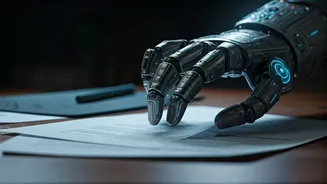


Your New Digital Supervisor
Imagine having a guide who can, at 3 AM, instantly tell you if your thesis structure makes sense—if your introduction logically leads to your methodology, and if your conclusion circles back to your initial hypothesis. This is the promise of a new wave
of educational AI engines. These are not tools that write your paper for you. Instead, they act as sophisticated digital proofreaders, focusing specifically on the architectural integrity of your academic work. Tools like Paperpal, Trinka, and advanced versions of Grammarly are being trained on millions of academic papers to recognise the hallmarks of a well-structured thesis. They go far beyond simple grammar and spelling checks to analyse the flow, coherence, and organisation of your arguments.
How It Checks the Blueprint
So, what does reviewing a 'structural layout' actually mean? These AI tools perform several key checks. First, they analyse the document's IMRaD (Introduction, Methods, Results, and Discussion) format, a standard for many scientific papers, ensuring each section is present and correctly placed. They can flag if your 'Results' section seems to be missing data tables or if your 'Discussion' doesn't sufficiently interpret those results. Second, the AI evaluates coherence. It looks for a clear 'golden thread'—a central argument that runs consistently from the thesis statement through each chapter and into the conclusion. It can highlight paragraphs or sections that seem to deviate from the main topic. Finally, it assists with formatting consistency, checking citations, headings, and subheadings to ensure they adhere to university style guides like APA or MLA, a tedious task that often costs students valuable marks.
The Benefits for Indian Students
For students across India, the potential benefits are significant. The pressure to produce a high-quality thesis is immense, and not every student has equal access to faculty guidance. These AI tools can act as a great equaliser. They provide instant, private, and non-judgemental feedback, helping students identify structural weaknesses early on. This is particularly valuable for students who may be brilliant researchers but struggle with academic writing conventions, or for those writing in English as a second language. By handling the structural and formatting feedback, the AI frees up both the student and their human supervisor to focus on what truly matters: the quality of the research, the depth of the analysis, and the originality of the ideas.
The Professor's Dilemma
Naturally, the rise of these tools brings a healthy dose of scepticism. Educators worry about over-reliance. If an AI points out all the structural flaws, does the student ever learn how to build a strong argument on their own? There's a risk of creating a generation of students who are excellent at following an AI's suggestions but lack the underlying critical thinking skills to structure work independently. Furthermore, there's the concern of homogenisation. If everyone uses the same AI, will all theses start to look and sound the same, potentially stifling creative or unconventional approaches to academic writing? The line between a helpful tool and a cognitive crutch is a thin one, and universities are now grappling with how to draw it.
Striking the Right Balance
The consensus is that banning these tools is not the answer; they are already too integrated to be excised. The path forward lies in education and ethical guidelines. Universities need to update their academic integrity policies to differentiate between using AI for structural feedback (often acceptable) and using it for content generation (plagiarism). Professors can integrate these tools into their teaching, showing students how to use them as a first-pass review before engaging in deeper, more substantive revisions. The goal is to foster a new kind of digital literacy where students learn to partner with AI, using it to enhance their skills rather than replace them. The AI can check the blueprint, but the student must still be the architect.