





Successes Confirmed, Assumptions Tested
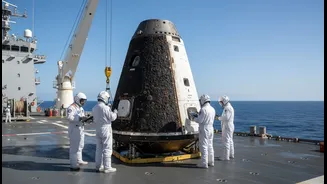
The return of the Orion capsule from its crewed lunar flyby was a landmark achievement. For engineers, the real work began after splashdown. Post-flight inspections are a critical part of any test campaign, designed to validate that the spacecraft performed
as models predicted. For Artemis II, the primary goals were to demonstrate that the Space Launch System rocket and Orion could safely fly a crew on a lunar trajectory and return them to Earth. Initial checks have confirmed the overall structural health of the capsule and the successful operation of its primary systems. The mission validated launch, in-space maneuvers, and the punishing physics of a high-speed reentry. The data gathered provides a solid foundation, confirming that the fundamental design is sound. Every piece of information, from sensor readings to the physical state of the hardware, helps refine the models for Artemis III, the mission slated to land astronauts on the Moon.
The Lingering Heat Shield Mystery
A major focus of the post-flight analysis is the heat shield. This is Orion’s only defense against the 5,000-degree Fahrenheit temperatures of reentry. Following the uncrewed Artemis I mission, inspections revealed unexpected erosion and chunking of the ablative material, Avcoat. While NASA determined the issue was related to gas pressure building up within the material and adjusted the Artemis II reentry profile accordingly, post-flight checks have their limits. Engineers can see the end result—how much material burned away and where—but they cannot perfectly reconstruct the dynamic, second-by-second performance during the fiery descent. Ground tests can't fully replicate the unique combination of heat, pressure, and speed of a lunar return. Therefore, while analysis can confirm the heat shield worked, it cannot definitively prove that all the modeling uncertainties that surprised engineers after Artemis I are fully resolved for future, potentially more demanding, missions.
A Snapshot of Life Support
Artemis II was the first real-world test of Orion's environmental control and life support systems (ECLSS) with a human crew in deep space. For approximately ten days, the system managed the atmosphere, water, and waste for four astronauts. Post-flight data will show how much power it consumed, how efficiently it recycled resources, and how it handled the metabolic load of a working crew. However, a ten-day mission offers only a limited data set. It cannot fully prove the system's reliability and resilience over the longer and more complex Artemis III mission, which will involve a lunar orbit, the departure and return of a lander, and different thermal stresses on the spacecraft. Checks can confirm the system worked flawlessly for this flight profile, but they can't simulate the accumulated wear and tear or the potential for unforeseen issues that might arise during a mission lasting weeks longer.
The Unpredictability of Deep Space
One of the key unknowns for any lunar mission is radiation. Beyond Earth's protective magnetic field, astronauts and electronics are exposed to a constant shower of galactic cosmic rays and the unpredictable fury of solar particle events (SPEs), or solar storms. The Artemis II crew wore dosimeters to measure their exposure, and the capsule's components are being analyzed to see how they withstood the environment. This data is invaluable, providing a real-world baseline. Yet, it represents just one trip through this harsh environment. Post-flight analysis can confirm the total radiation dose received and check for immediate damage to electronics. What it cannot prove is that the shielding is adequate for a major, unpredicted SPE. The timing of such events is largely a matter of chance, so a successful ten-day flight doesn't guarantee safety on the next one. It provides a single, crucial data point, but not a complete statistical picture of long-term risk.