




Who Just Joined the Chat?
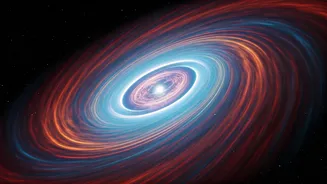
Imagine the universe as an enormous, sprawling network. It’s not a random scattering of stars and galaxies, but a structured web of matter connected by impossibly long threads. These threads, known as cosmic filaments, are made of gas and invisible dark
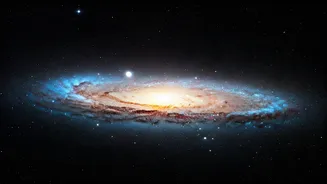
matter. At the intersections of these filaments, where matter is densest, galaxies are born and cluster together. This entire structure is called the cosmic web, and it's the largest-known architecture in existence. Recently, astronomers have been getting unprecedented looks at this web, particularly its most ancient parts. Discoveries like the 'Big Ring', a ring-like assembly of galaxies about 1.3 billion light-years in diameter, are so enormous they challenge existing theories about the universe. Another structure, named Quipu after the knotted Incan recording devices it resembles, is a newly discovered collection of 68 galaxy clusters stretching over 1.4 billion light-years. These are the universe's hidden highways and foundational superstructures, and they're finally coming into focus.
Reading the Ancient DMs
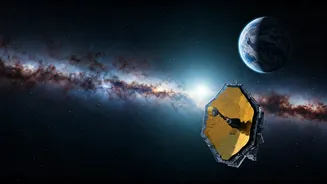
So how are scientists reading messages that are billions of years old? The credit goes to a new generation of powerful telescopes and clever techniques. The James Webb Space Telescope (JWST) has been a game-changer, able to peer back to the universe's infancy with stunning clarity. By detecting the faint, stretched-out light from objects that are billions of light-years away, Webb is essentially a time machine. Another method, called Line Intensity Mapping, allows astronomers to detect the combined glow of many faint, distant objects that would be invisible on their own. Using this technique, the Hobby-Eberly Telescope Dark Energy Experiment (HETDEX) created the largest 3D map of the early universe, charting a sea of energized hydrogen from 9 to 11 billion years ago. This allowed them to see not just the bright galaxies, but also the vast, dim structures of gas connecting them, filling in the gaps of the cosmic web.
Why the Group Chat Is Buzzing
These discoveries are causing a stir because some of these structures are larger and more developed than cosmological models predict should be possible so early in the universe's history. The standard model of cosmology is built on the 'Cosmological Principle', which assumes that on a large enough scale, matter is distributed fairly evenly. But structures like the Big Ring and the Giant Arc, a neighboring 3.3-billion-light-year-long formation, are so massive they push the theoretical size limit. Finding two such colossal structures so close to each other is even more baffling. It's like finding twin skyscrapers in a village that's supposed to be made of mud huts. These findings suggest that the story of how the universe evolved might need some significant revisions. Some discoveries even show galaxies in these filaments rotating in sync with the entire structure, a coordinated dance across millions of light-years that current models struggle to explain.
What It Means for the Rest of Us
While the finer points are debated by cosmologists, the bigger picture is one of breathtaking discovery. We are living in an era where we are not just discovering new planets or stars, but the very scaffolding upon which the cosmos is built. These ancient structures are the fossil record of the universe's birth. By studying the shape of these filaments and the composition of the earliest galaxies, scientists can test their theories about everything from the Big Bang to the nature of dark matter. For example, the discovery of a galaxy with surprisingly complex chemistry existing just 300 million years after the Big Bang suggests that the first generations of stars formed even earlier than we thought. Each new map and each ancient galaxy adds a new, crucial piece to the puzzle of our cosmic origins. It's a reminder that the universe is not a static backdrop, but a dynamic, evolving entity with a history that is only just beginning to be read.