


A Sweet Discovery in Cosmic Rocks
Scientists have long suspected that the ingredients for life might have been delivered to a young Earth by cosmic couriers like asteroids and comets. Now, they have some of the sweetest proof yet. An international team of researchers discovered ribose,
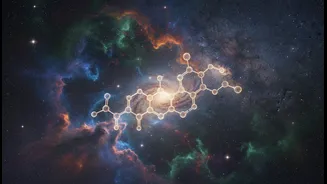
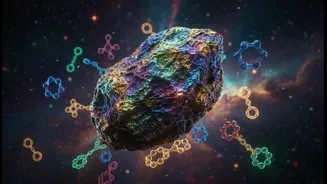
a type of sugar, within samples from two separate, carbon-rich meteorites. This wasn't just any sugar; ribose is the crucial sugar component that forms the backbone of RNA (ribonucleic acid). In modern life, RNA acts as the essential messenger that reads our DNA and translates its instructions into proteins. The discovery of ribose in meteorites is significant because while amino acids (protein building blocks) and nucleobases (DNA/RNA components) had been found before, sugar was the missing piece of the puzzle.
The Blueprint of Life
Why is this sugar so special? Think of life as an incredibly complex construction project. You need raw materials (elements like carbon and hydrogen), structural components (amino acids for proteins), and, crucially, a blueprint. On Earth, that blueprint is DNA. However, many scientists support the 'RNA World' hypothesis, which posits that before DNA-based life evolved, simpler life forms used RNA to both store genetic information and catalyze chemical reactions. The discovery of extraterrestrial ribose, the 'R' in RNA, provides strong direct evidence for this theory. Interestingly, the sugar for DNA, 2-deoxyribose, was not found in the meteorite samples. This suggests there may have been a cosmic delivery bias, with the building blocks for RNA arriving on early Earth in greater abundance, giving it a head start in the origin of life.
From Meteorite to Lab
Finding these fragile molecules was a feat of scientific detective work. Researchers from NASA and Tohoku University in Japan analyzed powdered samples from the Murchison and NWA 801 meteorites. Using a sophisticated technique called gas chromatography mass spectrometry, they could separate and identify molecules based on their mass and charge. To ensure the sugars weren't simply contamination from Earth, the team analyzed their carbon isotopes. Molecules formed in space tend to have more of a heavier carbon variant, carbon-13. The sugars they found had this tell-tale isotopic signature, confirming their extraterrestrial origin. This work builds on earlier lab experiments where scientists at NASA's Ames Research Center successfully created DNA's sugar, 2-deoxyribose, by simulating the conditions of interstellar space—blasting ice with UV radiation—proving that these essential compounds can indeed form in the cosmos.
A Universe Ripe for Life?
This discovery does not mean we've found aliens. What it does mean is that the fundamental building blocks of life as we know it are not an exclusive feature of our planet. They are synthesized in asteroids and scattered throughout space by meteorites. This concept, known as panspermia or pseudo-panspermia, suggests that life doesn't necessarily need to start from scratch on every habitable planet. Instead, the universe may be constantly seeding worlds with the necessary organic ingredients. If the raw materials for RNA—and potentially life itself—are common, then it raises the tantalizing possibility that life could have emerged elsewhere. As one NASA scientist put it, "The universe is an organic chemist." These findings reinforce that the presence of life's building blocks may not be the limiting factor in whether life exists beyond Earth.