




A Cosmic Measuring Tape Dispute
For decades, astronomers have been trying to pin down the exact speed of the universe's expansion, a value known as the Hubble Constant. The problem is that the two main methods for measuring it give two different answers. One method, which studies the leftover
light from the Big Bang, called the Cosmic Microwave Background (CMB), suggests an expansion rate of about 67 kilometres per second per megaparsec. The other method, which uses stars and supernovae in the local universe as 'standard candles' to measure distances, points to a faster rate of around 73. This disagreement, known as the 'Hubble Tension', is one of the most significant puzzles in modern cosmology. It suggests that either our measurements are wrong, or our fundamental understanding of the universe, the Standard Model of Cosmology, is incomplete.
Enter CHIME and its Cosmic Messengers
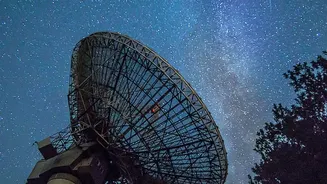
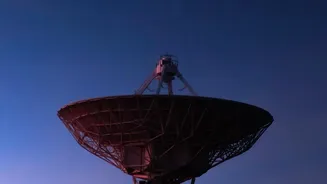
This is where the Canadian Hydrogen Intensity Mapping Experiment (CHIME) comes in. Located in British Columbia, CHIME is a revolutionary radio telescope with no moving parts, shaped like four massive half-pipes. It excels at detecting Fast Radio Bursts (FRBs), which are incredibly powerful but brief flashes of radio waves from deep space. The origin of these millisecond-long bursts is still a mystery, but they are extremely useful. As an FRB travels across billions of light-years, its signal gets slightly delayed by the matter it passes through in the vast emptiness of space. By measuring this delay, a property called 'dispersion measure', scientists can effectively 'weigh' the universe and determine the distances these signals have travelled. This provides a third, independent way to measure cosmic distances and, by extension, the universe's expansion.
What the New Data Reveals
While CHIME is famous for cataloguing thousands of FRBs, recent research highlights another of its key missions: mapping the distribution of hydrogen gas throughout the universe. Hydrogen is the most abundant element, and its faint radio glow acts as a tracer for the large-scale structure of the cosmos. In a recent breakthrough announced in The Astrophysical Journal, the CHIME collaboration successfully detected this faint hydrogen signal from when the universe was about five billion years old, using only CHIME's own data for the first time. This achievement is a proof-of-concept, showing that the telescope's 'intensity mapping' technique works. By creating a 3D map of hydrogen, scientists can measure the imprint of Baryon Acoustic Oscillations (BAO) — ancient pressure waves from the early universe that serve as a standard cosmic ruler to track expansion over time.
A New Path to Understanding Dark Energy
This hydrogen mapping method gives scientists a powerful new tool to study dark energy, the mysterious force believed to be driving the accelerated expansion of the universe. Previously, CHIME had to cross-reference its findings with more expensive and time-consuming optical galaxy surveys. Being able to work independently makes the process much faster and more cost-effective. While the recent findings do not yet provide a new measurement of the Hubble Constant, they confirm that the methodology is sound. This 'flag in the sand' moment, as one researcher described it, proves that CHIME can gather the necessary data to eventually make its own independent measurement of cosmic expansion. With nearly seven years of observations already collected, the team can now apply this technique to map the universe even further back in time, promising a much clearer picture of how our cosmos has evolved.