




First Off, What Is Quantum Communication?
Imagine sending a secret message in a bubble so fragile that the slightest touch from an eavesdropper would instantly pop it, alerting both you and the intended recipient. That's the basic idea behind quantum communication. Instead of relying on complex
math problems that future supercomputers might solve, it uses the fundamental laws of physics. The most common method is Quantum Key Distribution (QKD), where encryption keys are encoded onto single particles of light (photons). According to quantum mechanics, the very act of observing a quantum particle changes it. This means any attempt to intercept the key would alter the photons, leaving a detectable trace and rendering the key useless. This makes the communication channel theoretically 'unhackable' and 'future-proof,' a massive leap beyond today's encryption standards which could one day be broken by powerful quantum computers.
India's Breakthroughs on the Ground
India isn't just theorizing; it's actively building. In April 2023, the government approved the National Quantum Mission (NQM) with an infusion of over $700 million to be deployed through 2031. The goal is to make India a leading nation in quantum technologies. The mission has already yielded impressive results on the ground. Researchers from organizations like the Defence Research and Development Organisation (DRDO) and the Indian Space Research Organisation (ISRO) have successfully demonstrated QKD over various distances. ISRO achieved a successful free-space demonstration over 300 meters, including a live video conference using quantum-encrypted signals. More recently, India's NQM announced it had established 1,000 kilometers of secure quantum communication lines, a significant step toward its goal of a 2,000-kilometer network. This progress shows that India can implement this advanced technology using its existing fiber-optic infrastructure.
Why Space Is the Final Frontier
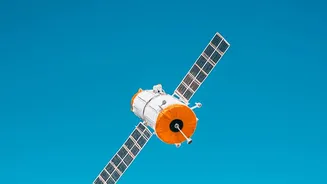
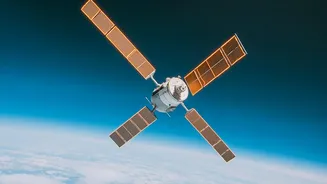
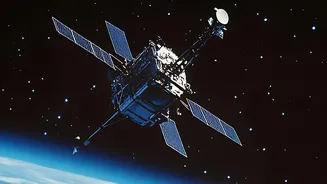
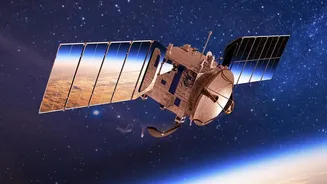
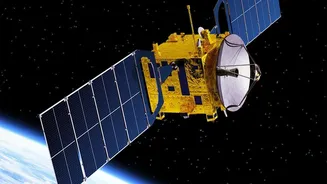
While impressive, ground-based quantum communication has a fundamental limitation: distance. Sending single photons through kilometers of fiber-optic cable or even through the air leads to signal loss, making it difficult to establish secure links over transcontinental or global distances. Satellites solve this problem. By beaming quantum signals from space, a single satellite can connect ground stations thousands of kilometers apart, creating a secure key that can then be used to encrypt data sent over conventional networks. This is the ultimate goal: a global, satellite-based quantum communication network. India's National Quantum Mission explicitly includes this objective, aiming to demonstrate satellite-based secure communication between ground stations over 2,000 kilometers apart. ISRO is actively preparing for this next phase, which would revolutionize secure data transfer for defense, finance, and critical infrastructure.
The Geopolitical Quantum Race
India's ambition places it in a high-stakes technology race with global powers. China is the undisputed frontrunner in space-based quantum communication, having launched its Micius satellite back in 2016 and using it to conduct the world's first quantum-encrypted intercontinental video call. The United States, while a leader in quantum computing research, has largely focused on developing software-based quantum-resistant algorithms (PQC) and is seen as playing catch-up in the quantum satellite domain. Europe and Canada are also developing their own quantum satellite projects, aiming for launches in the coming years. India's progress positions it as a crucial third pole in this race. By developing its own sovereign capability, India not only secures its own communications but also becomes a vital strategic partner for the U.S. and other democratic nations looking to build a secure technological ecosystem independent of autocratic rivals. The global investment in quantum has already surpassed $40 billion, signaling its immense strategic importance.