




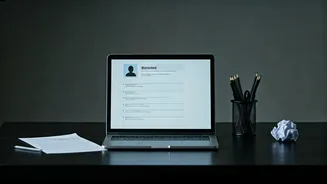




What is a Portfolio Mindset?
A portfolio mindset means you shift from being a temporary helper to a strategic collector of evidence. It's about looking at every task, project, and meeting as an opportunity to create a tangible asset for your future. Instead of just listing 'assisted
the marketing team' on your resume, you aim to walk away with proof: a campaign summary you wrote, data you helped analyse, or a presentation you contributed to. This approach forces you to think about the output and outcome of your work, not just the process. The goal is to finish the internship with a collection of work that tells a compelling story about your skills and contributions.
Think Like a Consultant, Not Just an Intern
Consultants are hired to solve specific problems and show their work. Adopt this approach. For every major task you're given, frame it as a mini case study. Document the problem or objective (e.g., 'increase engagement on a social media post'), your specific role and actions ('I researched trending audio and drafted three caption options'), the tools you used, and the result ('the post achieved 15% higher reach than the account average'). This method transforms mundane tasks into structured, professional stories that are perfect for interviews and your portfolio. It shows you understand not just the 'what' but the 'why' behind your work.
Document Everything (The Smart Way)
Your memory will fail you. From day one, keep a journal or a digital document to track your activities. Note down your key responsibilities, the people you meet, the software you learn, and any feedback you receive. Crucially, ask for permission before saving copies of your work, especially if it contains sensitive company information. If you can't save the final product, write a detailed description of the project and your involvement. Take screenshots of non-sensitive work, save links to public-facing projects, and even document your process to show how you think. This documentation is gold for building your resume and preparing for future interviews.
Turn Your Tasks into Demonstrable Skills
Employers in India are actively looking for competencies like communication, analytical skills, and digital marketing expertise. A portfolio mindset helps you connect your daily tasks to these in-demand skills. Instead of saying you 'answered emails,' you can frame it as 'managed stakeholder communication for a project, ensuring timely updates.' Instead of 'making a spreadsheet,' it becomes 'analysed sales data using Excel to identify top-performing regions.' Always think about the underlying skill your task demonstrates. This allows you to build a portfolio that speaks directly to what hiring managers are looking for, showcasing your practical abilities beyond just theoretical knowledge.
Focus on Showcasing, Not Just Telling
A resume tells, a portfolio shows. Your portfolio is the proof. It could be a simple PDF, a personal website, or a well-organized folder on a cloud drive. For each item, include a brief description explaining the project and your role. If you worked on a team, be honest about your specific contributions. Quantify your impact whenever possible—use numbers, percentages, and concrete outcomes to demonstrate the value you added. A single, well-documented project that shows you can solve real-world problems is often more valuable to an employer than a long list of duties on a CV.