
Meet Pushpak, India’s Space Plane
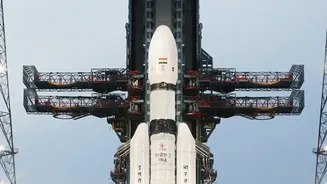
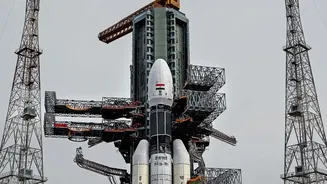
At the heart of this revolution is the Reusable Launch Vehicle-Technology Demonstrator (RLV-TD), affectionately nicknamed 'Pushpak' after the mythological flying palace. Unlike traditional rockets that are discarded after a single mission, Pushpak is designed
to function like a space plane. It combines the features of a rocket for launch with the characteristics of an aircraft for landing. The concept is straightforward but technologically profound: after deploying its payload in space, the winged vehicle is designed to fly back to Earth and land horizontally on a runway, just like an airplane. This ability to be recovered and reused is the key to its game-changing potential.
A 'Hat-Trick' of Successful Landings
While the journey is long, ISRO has achieved critical milestones. It has successfully completed a series of Autonomous Landing Experiments (LEX). The final test, LEX-03, conducted on June 23, 2024, saw Pushpak released from a Chinook helicopter at an altitude of 4.5 kilometres. From there, the vehicle autonomously navigated its way to a runway at the Aeronautical Test Range in Chitradurga, Karnataka, performing a perfect horizontal landing at speeds exceeding 320 kmph. What made this test even more significant was that it used the same winged body from the previous LEX-02 mission without any modifications, proving the robustness of ISRO's design for reusability.
The Billion-Dollar Question: How Does It Save Money?
The primary driver behind developing reusable technology is economics. For a conventional launch, the rocket hardware itself accounts for the vast majority of the total cost—some estimates place it as high as 80%. These incredibly expensive and complex components are typically lost forever after a single use, falling into the ocean or burning up in the atmosphere. A reusable system like Pushpak flips this model on its head. By recovering the most valuable parts of the launch vehicle, ISRO can refurbish and fly them again. This spreads the manufacturing cost over multiple missions, dramatically lowering the price tag for each launch. The ultimate goal is ambitious: to reduce the cost of sending payloads into space by as much as 80-90%, potentially bringing it down from around $20,000 per kilogram to as low as $2,000 per kilogram.
More Than Just Savings: A New Orbit for India
Lowering launch costs does more than just save money; it fundamentally changes what's possible in space. Cheaper access opens the door for more frequent scientific missions, such as those planned for the Moon and Venus, and the establishment of the Bharatiya Antariksh Station by 2035. It also makes India a much more competitive player in the multi-billion dollar global commercial launch market, allowing ISRO's commercial arm to offer attractive pricing to satellite companies and other nations. This accessibility can accelerate the deployment of large satellite constellations for communication, earth observation, and disaster management, providing direct benefits to people across the country.
What’s Next on the Launchpad?
The successful landing experiments are just the beginning. The RLV-TD is a technology demonstrator, a scaled-down version to test key systems. The next major step is the Orbital Re-entry Experiment (OREX). In this phase, a larger version of Pushpak will be launched into orbit on a conventional rocket. After orbiting the Earth, it will re-enter the atmosphere and perform an autonomous landing, testing crucial technologies like its heat shield and a new deployable landing gear system. These future tests will pave the way for a fully operational Two-Stage-to-Orbit (TSTO) vehicle, bringing India closer to its goal of sustainable and self-reliant spaceflight.