



From Your Feed to AI Fuel
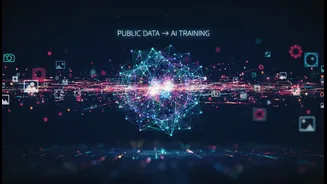
The process begins with data scraping, an automated technique where companies collect vast numbers of publicly available images from the internet, including social media platforms, blogs, and photo-sharing sites. These images, complete with their captions,
tags, and metadata, are compiled into enormous datasets. Tech giants like Meta (the parent company of Facebook and Instagram) have openly stated they use public user content, sometimes dating back over a decade, to develop and improve their AI models. Your photo of a sunset might teach an AI about colours and composition, while a picture from a family gathering helps it learn to recognise human faces, expressions, and social interactions. This content effectively becomes the fuel for the generative AI revolution, powering everything from chatbots to image generators.
Big Tech's Unending Appetite for Data
The race to build more powerful and capable AI has created an insatiable demand for training data. Companies from OpenAI to Google and Meta are all engaged in this large-scale data harvesting. Meta, for instance, updated its policies to clarify that public posts, photos, and captions on Facebook and Instagram are fair game for training its generative AI. The company states it does not use private messages or content shared only with friends, but anything posted publicly is used to refine its systems. Recently, Meta rolled out a feature called Muse Image, which allows users to tag public Instagram profiles to generate new AI images based on that person's photos, often without notifying the original account holder.
The Hidden Dangers of Digital Reuse
When your personal photos are absorbed into an AI model, you lose control over your own image. The risks go far beyond simple reuse. Your likeness could be used to train facial recognition systems for surveillance without your knowledge or consent. Malicious actors can use AI to create convincing deepfakes—manipulated images or videos—for blackmail, scams, or harassment. There have been cases where scammers used AI-generated voice clones of children to demand ransom from parents. Furthermore, there is a risk of private information being unintentionally leaked, as AI models can sometimes reproduce the exact data they were trained on, including sensitive details from photos or captions.
A Legal and Ethical Minefield in India
The legality of data scraping for AI training is a major grey area, particularly in India. Indian law does not explicitly define or regulate data scraping. While the Copyright Act, 1957, protects creative works, it is unclear whether copying data for AI training constitutes infringement. The government has sent mixed signals. On one hand, the Digital Personal Data Protection Act (DPDPA) of 2023 includes an exemption for personal data that is made publicly available. On the other hand, government officials have stated that companies scraping public data must still obtain consent, creating a contradiction. This legal uncertainty leaves Indian users in a vulnerable position as global tech companies continue to operate in this space with few clear rules.
Can You Safeguard Your Digital Memories?
While completely stopping AI from using your public data is difficult, you can take steps to reduce your exposure. The most effective method is to make your social media accounts private. This restricts access to your content. For public accounts on platforms like Instagram, you can go into your settings under "Sharing and reuse" and disable options that allow your content to be used for AI features. However, it's important to note that this may not stop the platform itself from using your data for its own internal AI model training. Other protective measures include blurring faces, especially of children, before posting publicly, removing metadata like GPS locations from your photos, and being wary of third-party AI apps that generate filters or portraits, as they often reuse your images.