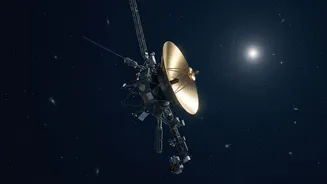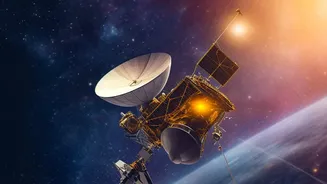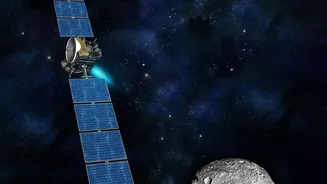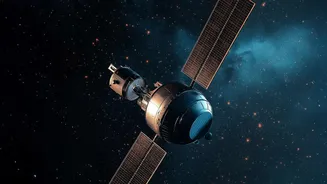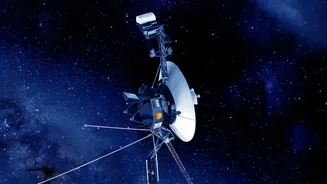



Nearly half a century after leaving Earth, a lone emissary from humanity is about to cross an invisible, yet profound, threshold. NASA’s Voyager 1 is poised to become the first human-made object to travel one light-day away from its home planet.
A Milestone Measured in Light
On November
18, 2026, Voyager 1 will be 25.9 billion kilometers away from Earth. That number is so vast it’s almost meaningless, which is why scientists use a more poetic yardstick: the speed of light. A light-day is the distance light travels in 24 hours. It means that on that day, the radio signals Voyager 1 sends back to us—traveling at the fastest speed the universe allows—will take a full day to arrive. A command sent from a NASA engineer will take another day to reach the distant probe, making a round-trip conversation a 48-hour affair. This isn't a physical boundary, but a communications one; a powerful illustration of the immense scale of space and the probe's lonely trek into the void.
An Unexpected Interstellar Explorer
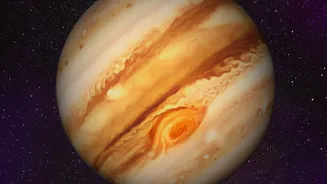
Voyager 1 wasn’t originally designed for this. Launched on September 5, 1977, its mission was the 'Grand Tour' of the outer solar system. Using gravity assists from Jupiter and Saturn, it slingshotted itself to incredible speeds. It gave humanity its first close-up views of Jupiter's swirling Great Red Spot and discovered active volcanoes on the moon Io. At Saturn, it unveiled new moons and the complexity of its iconic rings. After its planetary encounters ended in 1980, its journey was just beginning. In August 2012, it passed through the heliopause—the boundary where the Sun's solar wind ends—and officially entered interstellar space, the vast ocean between the stars.
A Triumph of 1970s Engineering
Keeping a nearly 50-year-old spacecraft alive is a masterclass in problem-solving. Its nuclear power source, a set of radioisotope thermoelectric generators, produces about 4 fewer watts of power each year. To conserve energy, NASA engineers have been methodically shutting down instruments and heaters. Recently, the team performed a complex power-saving maneuver nicknamed the 'Big Bang' to extend the life of its remaining science instruments. The probe has also survived numerous scares, including a recent memory chip failure that garbled its data for months and a 48-hour communication blackout, proving the resilience of its vintage technology. Today, just two instruments continue to 'hear' the vibrations of interstellar plasma and measure the magnetic fields beyond our solar system.
Humanity's Message in a Bottle
Beyond its scientific value, Voyager 1 is a cultural ambassador. Attached to its side is the Golden Record, a 12 inch, gold plated copper disc intended as a message for any potential extraterrestrial civilization that might one day find it. Conceived by a committee led by famed astronomer Carl Sagan, the record contains a time capsule of life on Earth. It includes 116 images of our planet and its inhabitants, greetings in 55 languages, and a 90 minute eclectic mix of music, from Bach and Mozart to Chuck Berry's 'Johnny B. Goode'. It also carries natural sounds like wind, rain, whale songs, and human laughter. It is a symbolic gesture, an expression of hope and our desire to communicate our story to the cosmos.