





The Fragile Genius of Quantum
At the heart of a quantum computer is the qubit. Unlike a classical bit that is either a 0 or a 1, a qubit can be both at the same time, thanks to a principle called superposition. This allows quantum computers to explore a vast number of possibilities
simultaneously, promising exponential leaps in processing power. However, this power comes at a cost. Qubits are extraordinarily delicate. The slightest disturbance from their environment—a tiny change in temperature or a stray electromagnetic field—can cause them to lose their quantum state in a process called decoherence. This fragility leads to high error rates, which is the single biggest obstacle preventing us from building large-scale, practical quantum computers.
The Challenge of Correcting Errors
To build a reliable quantum computer, we need to shield the fragile qubits from noise and correct the errors that inevitably occur. This is the goal of Quantum Error Correction (QEC). The basic idea is to use multiple physical qubits to encode the information of a single, more robust 'logical qubit'. If an error affects one of the physical qubits, the system can detect and correct it without disturbing the overall computation. The problem is that QEC is itself a complex process. It requires constant monitoring and correction, performed faster than the errors accumulate. The classical computers used to manage this are often not fast enough, and the correction process itself can sometimes introduce more errors than it fixes.
An AI That Learns From Mistakes
This is where Reinforcement Learning (RL), a branch of artificial intelligence, enters the picture. RL works much like how we learn through trial and error. An RL 'agent' interacts with an environment and receives rewards or penalties for its actions. Over many iterations, it learns the optimal strategy to maximize its reward. Think of it like teaching a computer to play a game. At first, it makes random moves. But by rewarding it for good moves and penalizing bad ones, it eventually learns to play like an expert. This ability to learn complex strategies without explicit programming makes RL incredibly powerful.
AI as a Quantum Lifeguard
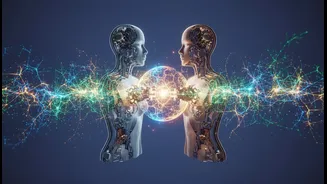
Researchers are now training RL agents to be quantum lifeguards. The agent monitors the quantum system, and its 'actions' are tiny adjustments to the control parameters that keep the qubits stable. Its 'reward' is a lower rate of errors. In a breakthrough, recent experiments have shown that an RL agent can learn to calibrate a quantum processor in real-time, while the error correction is running. It learns the unique quirks of the system and adapts to changes far more effectively than pre-programmed classical algorithms. By using RL, scientists have managed to significantly reduce the logical error rate, achieving new records in quantum computer stability.
Why This Race Matters for India
The successful fusion of AI and quantum computing isn't just an academic curiosity; it's a critical step in a global technology race. A functional quantum computer could unlock solutions to problems currently considered unsolvable. This includes designing new life-saving drugs by simulating molecules, creating novel materials, optimizing complex global supply chains, and revolutionizing financial markets. Realizing this potential, India has launched its own National Quantum Mission, a significant initiative with a budget of over ₹6,000 crore to foster research and development in quantum technologies. The mission aims to develop quantum computers, secure communication networks, and a vibrant ecosystem to position India as a key player in this emerging field.