





In the vastness of space, things are rarely as they seem. A distant world, once celebrated as a major discovery, appeared to vanish from sight, leaving astronomers to piece together the clues behind its mysterious disappearance.
The Case of the Vanishing Planet
About 1,000 light-years
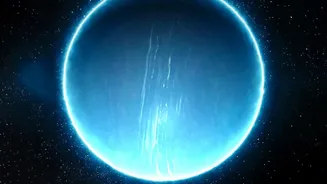
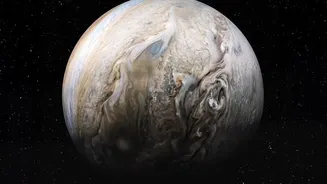
from Earth, a massive planet known as a 'hot Jupiter' has been playing a game of cosmic hide-and-seek. This planet, designated TOI-2535 b, was observed for seven years by NASA's Transiting Exoplanet Survey Satellite (TESS). Astronomers detect such worlds by watching for a tiny, periodic dip in a star's brightness, which occurs when a planet passes in front of it from our point of view. This event is called a transit. For years, TOI-2535 b reliably crossed its star every 8.25 days. But then, something strange started to happen. Its transits became irregular, sometimes arriving six hours early or late. Then, in March 2026, the planet seemingly failed to show up at all. The characteristic dip in starlight was gone, and the planet had, for all intents and purposes, disappeared.
An Invisible Dance Partner
So, how does a planet just vanish? The answer isn't that it exploded or was swallowed by its star. Instead, the new clarification points to something far more subtle: a gravitational dance with an unseen neighbour. Researchers analyzing the TESS data concluded that TOI-2535 b isn't alone. It has a planetary companion whose gravitational pull is affecting its orbit. Think of two spinning tops close together; they influence each other, causing them both to wobble. In this system, the two planets are locked in a gravitational tug-of-war that is causing the plane of their orbits to tilt dramatically. As team member Samuel Yee of the University of California, Los Angeles, noted, while we tend to think of the universe as a clockwork system, the presence of multiple planets can introduce these complex interactions.
A Shift in Perspective
The 'disappearance' of TOI-2535 b was a matter of perspective. For a transit to be visible from Earth, the planet's orbit must be perfectly aligned with our line of sight to its star. The intense gravitational wobbling caused by its unseen partner tilted TOI-2535 b's orbit just enough that it no longer crosses the face of its star from our viewpoint. According to the research team, this is the most extreme example of such a rapid orbital tilt ever witnessed; the planet's transit disappeared right as astronomers were watching. This same principle explains why we don't have solar and lunar eclipses every month; the Moon's orbit is slightly tilted relative to Earth's orbit around the Sun. In this case, the tilt became so pronounced that the planet is now hidden from our transit-based detection methods.
Science in Action
This cosmic mystery is a powerful illustration of the scientific method. What might have seemed like a 'lost' planet is actually a new discovery. The strange observations led to a deeper hypothesis that not only explains the missing planet but also confirms the existence of a second, yet-to be seen world in the same system. This is not the first time a 'planet' has vanished. The famous case of Fomalhaut b, once thought to be a directly imaged exoplanet, was later reclassified as a vast, dissipating dust cloud from a collision between two smaller bodies. Each of these instances, whether it's a cosmic dustup or a gravitational wobble, refines how astronomers search for and confirm worlds beyond our solar system. They are not failures, but crucial steps in building a more accurate picture of how planetary systems form and evolve.