




A Digital Doomsday Simulation
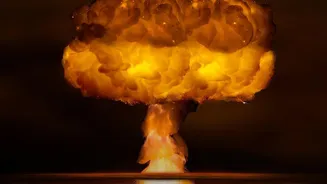
Researchers from the University of Wisconsin-Madison and Princeton University recently explored a frightening 'what-if' scenario. They modeled the effects of a one-megaton nuclear detonation approximately 500 kilometers above the Earth. The objective
wasn't to predict an imminent attack, but to stress-test the modern world's reliance on the thousands of satellites that now swarm in low-Earth orbit. The results, published on the preprint server arXiv, paint a picture of rapid, widespread technological degradation. According to the simulation, the initial blast is not even the greatest threat. The real danger comes from what follows: an artificial radiation belt, created by charged particles trapped in Earth’s magnetic field, that would systematically fry the electronics of any satellite passing through it.
A Cascade of Failures
The simulation showed a catastrophic and rapid domino effect. Within the first 24 hours of the hypothetical blast, 25% of the satellite network would be disabled. After three days, that number would jump to 78%. By the end of a single week, a staggering 98% of the more than 17,000 satellites in low-Earth orbit would be rendered inoperable. Even if future satellites were built with three times the current radiation tolerance, the model predicted that 97% would still fail within two weeks. This isn't just science fiction; the United States conducted a high-altitude nuclear test called Starfish Prime in 1962, which created a similar, albeit smaller, radiation belt that damaged several of the few satellites in orbit at the time. Today, with our far greater dependence on orbital systems, the consequences would be immeasurably more severe.
The Kessler Syndrome Unleashed
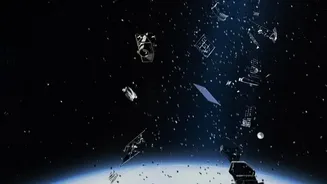
The problems wouldn't stop with disabled satellites. The loss of maneuverability for thousands of now-defunct spacecraft would drastically increase the probability of collisions. The simulation projected this would lead to around 20 orbital collisions within two years, compared to the usual rate of about one. This is the dreaded 'Kessler Syndrome' in action, a scenario where collisions create debris, which in turn causes more collisions, leading to a runaway chain reaction. This cascade could generate thousands of new pieces of high-speed space junk, making low-Earth orbit a hazardous minefield for years, if not decades. Any attempt to replace the lost infrastructure would be incredibly difficult, as new satellites would have to be launched into the same deadly environment of elevated radiation and debris.
Why This Hypothetical Matters Now
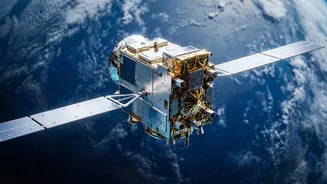
This study arrives at a critical moment. The number of active satellites has exploded in recent years, driven by the deployment of 'mega-constellations' by companies like SpaceX's Starlink, Amazon, and OneWeb. These networks are the backbone of a rapidly growing global space economy, providing everything from global internet and GPS navigation to weather monitoring, financial transactions, and critical military communications. A prolonged degradation of these services would disrupt modern society on a fundamental level. While this research was based on a hypothetical explosion, it highlights the immense vulnerability of our hyper-connected world and serves as a powerful argument for international treaties that prevent the weaponization of space.
Searching for Solutions in a Crowded Sky
Preventing an orbital catastrophe is now a major focus for space agencies and private companies. The most obvious solution is diplomatic: strengthening international agreements like the Outer Space Treaty to prohibit any weapons in orbit. On the technical side, significant research is going into Active Debris Removal (ADR). Missions scheduled for 2026, such as the European Space Agency's ClearSpace-1 and Japan's ADRAS-J2, aim to demonstrate technologies like robotic claws and advanced inspection capabilities to capture and deorbit large pieces of space junk. Other proposed solutions include nets, harpoons, and even ground-based lasers to nudge debris out of orbit. Experts believe that removing just five of the largest defunct objects from key orbits each year could be enough to stabilize the debris environment and prevent a runaway Kessler Syndrome.