





The Sun's Hidden Danger
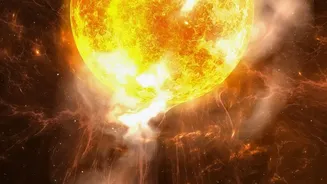
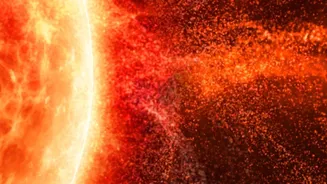
The Sun, our source of light and life, has a violent side. It periodically releases enormous bursts of energy and matter in events known as solar flares and Coronal Mass Ejections (CMEs). While flares are intense flashes of radiation, CMEs are colossal
clouds of magnetised plasma hurled into space at millions of kilometres per hour. If a CME is aimed at Earth, it can have severe consequences. These solar storms can trigger geomagnetic storms in our planet's magnetic field, posing a direct threat to technology. The most intense events can induce powerful electrical currents in power grids, leading to blackouts, and bombard satellites with high-energy particles that can damage or destroy their sensitive electronics.
An Increasingly Vulnerable Space Economy
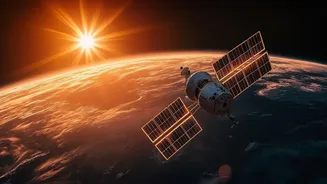
The global economy's reliance on space is growing exponentially. This 'space economy' includes thousands of active satellites responsible for everything from telecommunications and broadcasting to financial transactions, weather forecasting, and navigation services like GPS. A single, powerful CME could disrupt these services, causing widespread chaos and significant financial losses. In 2022, a relatively modest geomagnetic storm was enough to cause the loss of dozens of newly launched Starlink satellites by increasing atmospheric drag and pulling them out of orbit. This event highlighted the vulnerability of our expanding satellite constellations and the economic necessity of preparing for space weather.
Creating an Artificial Eclipse in Space
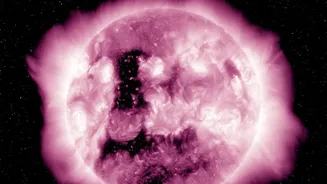
The key to protection is early detection, and the primary tool for this is the coronagraph. The Sun's surface, or photosphere, is so bright that it completely overwhelms the light from its much fainter outer atmosphere, the corona, where CMEs originate. A coronagraph is a specialised telescopic instrument designed to create an artificial solar eclipse. It uses an occulting disk to block the direct light from the Sun's bright face, allowing scientists to see the faint corona and, crucially, to watch for the massive eruptions of plasma that signal a CME. By observing these events as they leave the Sun, we can gain a vital head start.
India's Eye on the Sun
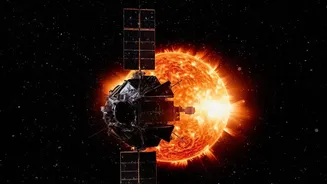
For decades, missions like the ESA/NASA Solar and Heliospheric Observatory (SOHO) have used coronagraphs to provide data on solar activity. More recently, new and advanced instruments have joined the effort, significantly enhancing our monitoring capabilities. A prime example is India's first dedicated solar observatory, Aditya-L1, launched by ISRO in 2023. Positioned 1.5 million kilometres from Earth at the Lagrange point L1, Aditya-L1 has an uninterrupted view of the Sun. Its Visible Emission Line Coronagraph (VELC) payload, along with other instruments, provides crucial data on the origin and dynamics of CMEs. These observations, particularly from an Indian-led mission, are a significant step forward in our global ability to study and predict space weather.
From Detection to Mitigation
Detecting a CME with a coronagraph is the first critical step. Once an Earth-directed CME is identified, forecasters can analyse its speed and trajectory to predict its arrival time, which can be anywhere from one to three days. This warning doesn't allow us to stop the storm, but it provides a crucial window for action. Satellite operators can put their spacecraft into a protective 'safe mode', turning off sensitive electronics to prevent damage from radiation. Power grid operators can prepare for induced currents, and airlines can reroute flights away from polar regions where radiation risks are highest. This early warning system, enabled by coronagraph technology, transforms a potential catastrophe into a manageable event, safeguarding billions of dollars in assets both in space and on the ground.