


A Star System of Superlatives
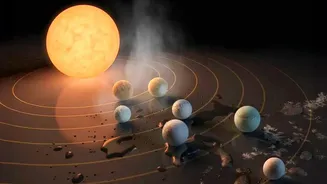
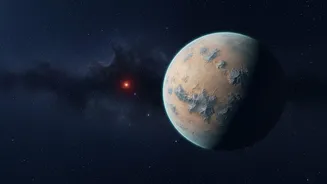
The TRAPPIST-1 system is one of the most remarkable planetary systems discovered to date. Located a relatively close 40 light-years from Earth, it features seven planets, all roughly the size of Earth, orbiting a tiny, ultracool red dwarf star. What makes
this system so compelling is that several of these planets orbit within the star's 'habitable zone' — the region where conditions might be just right for liquid water to exist on a planet's surface. This has made TRAPPIST-1 a prime target for the JWST, as scientists seek to understand the conditions on these distant worlds and whether they could potentially harbor life. The planets are packed tightly around their dim star, with 'years' that last only a few Earth days. This unique configuration provides an unparalleled natural laboratory for studying the formation and evolution of Earth-sized planets outside our own solar system.
A Glimpse of Alien Skies
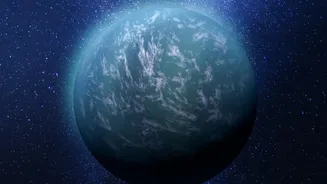
The latest observations from JWST have delivered a groundbreaking confirmation: some of the rocky worlds in the TRAPPIST-1 system possess atmospheres containing carbon-based molecules, most likely carbon dioxide. This finding moves beyond speculation and provides concrete evidence of a secondary atmosphere — one that is not the primordial hydrogen and helium from the star's formation, but one that could be generated by geological activity like volcanoes. Previous observations had been ambiguous, with some studies suggesting the innermost planets might be bare rocks stripped of their air by the star's radiation. However, these new, definitive detections on planets further out in the system, likely including the habitable-zone worlds TRAPPIST-1e and 1f, mark the first time we have confirmed a carbon-rich atmosphere on a potentially habitable, Earth-sized exoplanet.
How the Telescope Tastes the Air
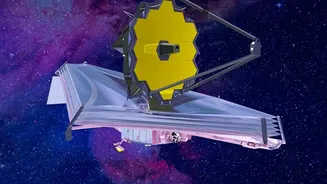
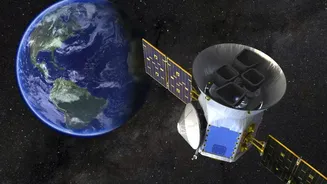
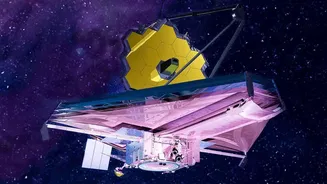
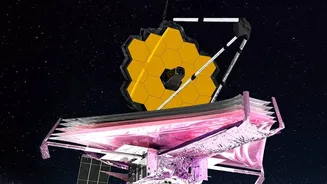
So how can a telescope nearly 40 light-years away detect what's in the air of a tiny planet? The technique is called transmission spectroscopy. When one of the TRAPPIST planets passes in front of its star from our point of view — an event called a transit — a tiny fraction of the starlight shines through the planet's atmosphere. The powerful instruments aboard the JWST, like its Near-Infrared Spectrograph (NIRSpec), can capture this filtered light and spread it into a rainbow-like spectrum. Different gases in the atmosphere absorb light at very specific wavelengths, leaving a unique chemical fingerprint on the starlight. By analyzing which 'colors' are missing, astronomers can deduce the composition of the planet's atmosphere with remarkable precision. It's like identifying the ingredients in a recipe by tasting the final dish.
Why Carbon Is a Critical Clue
The confirmation of carbon dioxide is significant for several reasons. On Earth, CO2 plays a crucial role in the long-term carbon cycle that regulates our planet's climate, keeping it stable over geological timescales. Finding it on an exoplanet suggests that similar geological or chemical processes could be at play. Carbon is the fundamental building block of all life as we know it, forming the backbone of complex molecules from sugars to proteins. While the presence of CO2 is not by itself a sign of life — it can easily be produced by volcanoes and other non-biological processes — its detection is a critical first step. It tells us that the raw chemical ingredients associated with life are present in the atmospheres of these rocky worlds, making them even more compelling targets in the search for habitability.
Not Earth 2.0, But Something New
It is crucial to temper excitement with scientific caution. A carbon-rich atmosphere does not mean we have found Earth 2.0. The TRAPPIST-1 planets are very different from our own world. They orbit a volatile red dwarf star known for powerful flares, and they are likely tidally locked, with one side perpetually facing the star in unending daylight and the other in endless night. The confirmed presence of carbon dioxide could be the result of a runaway greenhouse effect, like on Venus, creating a scorching, uninhabitable surface. But even this would be a monumental discovery, teaching us about the 'habitable zone's' limits. These findings provide the first solid piece of a complex puzzle. We have moved from asking if these planets have atmospheres to asking what kind of atmospheres they have and what's happening within them.