
The Sun's Inevitable Decline
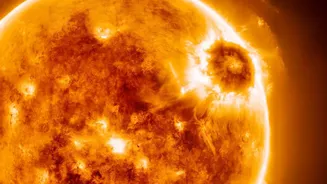
Like all stars, our Sun has a finite lifespan. For the past 4.6 billion years, it has been in its stable main sequence phase, fusing hydrogen into helium in its core. This process generates the energy that gives us light and warmth. But in about five
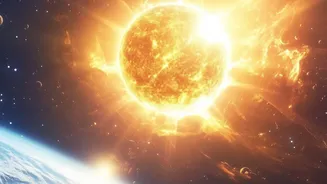
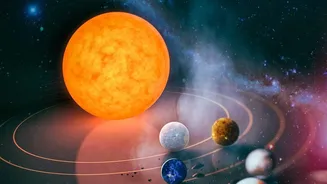
billion years, this fuel will begin to run out. The core will start to contract, heating up and causing the Sun’s outer layers to expand dramatically. This marks the beginning of the end, as the Sun transitions into a red giant. Its radius is expected to swell to around 100 times its current size, large enough to engulf the innermost planets.
A Fiery End for the Inner Planets
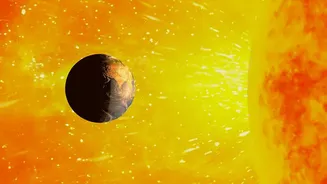
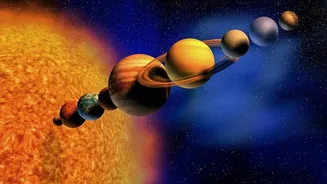
During its red giant phase, the Sun will become a destructive force. Its expanding atmosphere will almost certainly swallow and vaporise Mercury and Venus. Earth's fate is slightly less certain; some models suggest it might just escape being consumed, while others predict its destruction. Even if Earth survives being physically engulfed, it will not remain habitable. The Sun's increasing brightness will have boiled away our oceans long before, rendering the planet a scorching, lifeless rock. Mars, being farther out, is expected to survive the Sun's expansion, though it will experience extreme heating.
From Giant Star to Tiny Remnant
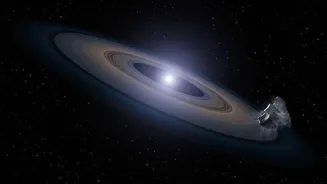
After about a billion years as a red giant, the Sun will enter its final stages. It will become unstable, shedding its outer layers into space to form a beautiful, glowing structure known as a planetary nebula. Left behind will be the Sun's incredibly hot and dense core: a white dwarf. This stellar remnant will be roughly the size of Earth but contain about half of the Sun's original mass. With no more nuclear fusion, the white dwarf will simply cool and fade over trillions of years, a dim ember where a brilliant star once shone.
A New, Unstable Gravitational Dance
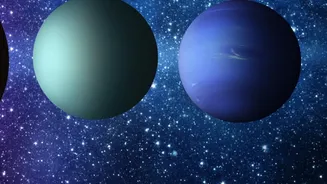
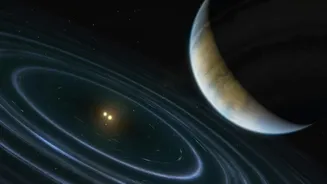
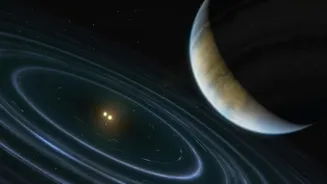
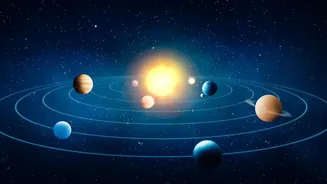
The transition to a white dwarf is the trigger for system-wide instability. As the Sun sheds nearly half its mass, its gravitational pull on the surviving planets will weaken significantly. This will cause the orbits of the outer planets—Jupiter, Saturn, Uranus, and Neptune—to expand, moving farther away from the dying star. For a long time, it was thought these giants would settle into new, stable orbits. However, recent and more detailed simulations suggest a much more chaotic future. The process of mass loss may not be smooth. Instead, the Sun could eject matter in asymmetric bursts, giving the star itself tiny 'kicks' that introduce subtle but powerful disturbances into the planets' orbits.
The Beginning of the End
These gravitational nudges, accumulating over millions of years, can throw the delicate orbital balance of the outer solar system into disarray. The planets' orbits, once separate and orderly, could begin to cross. This sets the stage for a cosmic billiards game, where the giant planets gravitationally scatter one another. New simulations published in 2026 suggest that this instability could emerge far sooner than previously thought, potentially within the first few billion years after the Sun becomes a white dwarf. In some scenarios, the chaos begins even before the red giant phase is complete. The once-stable architecture of our solar system would be dismantled, one planet at a time. The most likely outcome is that most of the outer planets will be ejected entirely, destined to wander the galaxy as lonely, 'rogue' planets.