




What is a ‘Waking’ Black Hole?
At the heart of most large galaxies, including our own Milky Way, lies a supermassive black hole, an object millions or billions of times the mass of our sun. For long stretches of cosmic time, these behemoths can be dormant, quietly sitting at the galactic
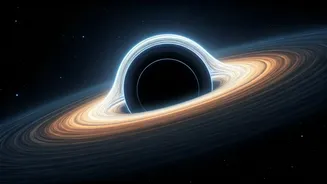
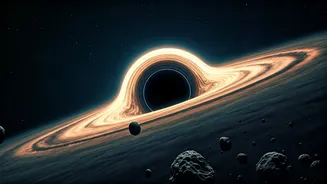
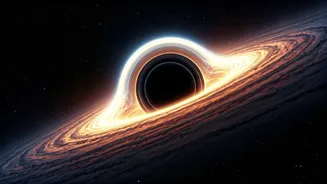
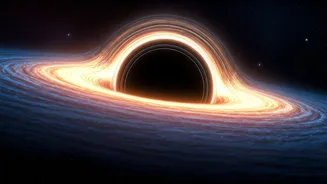
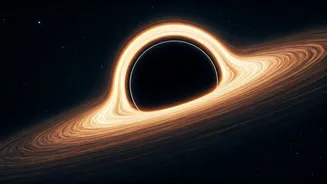
center. A 'waking' black hole is one that transitions from this quiet phase into an active one. This awakening is often triggered when a star or a large gas cloud strays too close and is captured by the black hole's immense gravity. The object is torn apart in what's known as a tidal disruption event (TDE), forming a swirling disk of superheated matter around the black hole. As this material falls inward, it releases tremendous amounts of energy, causing the black hole to blaze brightly across the electromagnetic spectrum. Recent observations have captured these 'reborn' black holes, some erupting after 100 million years of silence, providing a real-world look at a process that was once purely theoretical.
A Natural Laboratory for Extreme Physics
These transient events are a goldmine for astrophysicists. A waking black hole provides a natural laboratory to test the limits of physics in environments that cannot be replicated on Earth. Studying the flare of a TDE or the jets launched by a newly active black hole allows scientists to probe the physics of accretion disks, where matter is heated to millions of degrees and subjected to intense magnetic fields. Furthermore, these events generate ripples in the fabric of spacetime known as gravitational waves. Detecting these waves gives astronomers an entirely new way to 'hear' the universe, revealing details about the black hole's mass, spin, and even its very structure. Each awakening is a rare opportunity to gather data that can confirm or challenge fundamental theories, including Einstein's theory of general relativity, in the most extreme conditions imaginable.
The Hunt for Cosmic Transients
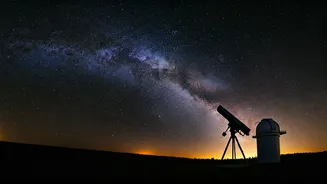
The unpredictable and fleeting nature of these events presents a major challenge—and a key driver for the next generation of astronomical missions. You can't schedule a black hole awakening. To catch them, astronomers need to continuously scan huge portions of the sky for anything that changes or flashes. This field is known as transient astronomy. The Vera C. Rubin Observatory, which began its 10-year Legacy Survey of Space and Time (LSST) in June 2026, is a game-changer in this effort. Located in Chile, Rubin will survey the entire southern sky every few nights, generating millions of alerts for transient events, including actively feeding black holes. This firehose of data will allow scientists to spot waking black holes almost as they happen, guiding other telescopes around the world for rapid follow-up observations.
Designing the Next Generation of Eyes
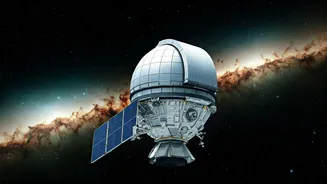
Beyond ground-based surveys, space missions are being designed specifically to study the high-energy phenomena associated with waking black holes. The European Space Agency's Laser Interferometer Space Antenna (LISA) mission, planned for launch around 2035, will be the first space-based observatory dedicated to detecting low-frequency gravitational waves. Comprised of three spacecraft flying in a triangular formation millions of kilometres apart, LISA will be sensitive to the mergers of supermassive black holes and the tell-tale ripples from stars being consumed—events that ground-based detectors can't pick up. Meanwhile, missions that look for X-rays and infrared light, like NASA's NuSTAR, are crucial for finding black holes hidden by clouds of galactic dust, giving us a more complete census of these events across all types of galaxies.
A New Era of Discovery
The ability to find and study waking black holes is fundamentally altering the strategy of astronomical science. It's shifting the focus toward rapid-response, multi-messenger astronomy—combining data from light, gravitational waves, and particles to get a complete picture of a cosmic event. This requires unprecedented global collaboration and sophisticated software, often powered by AI, to sift through terabytes of data nightly and identify promising candidates for study. The discovery of more waking black holes helps astronomers understand how these giants grow, how they influence the evolution of their host galaxies by driving out gas needed for star formation, and how often these dramatic events occur. Each new detection brings the observed rate of TDEs closer to theoretical predictions, solving long-standing puzzles about the lives of the universe's most enigmatic objects.