

A New Shape in the South
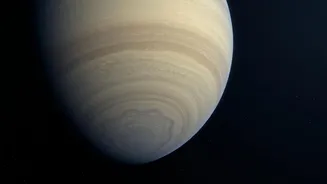
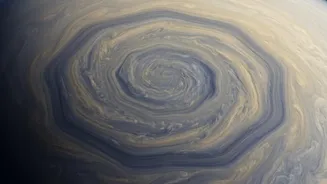
Recent images captured by the Hubble Space Telescope have revealed a massive, 10-sided atmospheric wave, or 'decagon', encircling Saturn's south pole. This is a landmark discovery, marking the first time scientists have observed such a large, regular-sided
jet stream pattern in the planet's southern hemisphere. For years, researchers have known about the persistent hexagonal storm at the north pole, a feature so stable it has been observed for over 40 years. The sudden appearance of a southern counterpart has sent a ripple of excitement through the astronomy community, suggesting we are witnessing a major atmospheric phenomenon as it unfolds.
Hubble's Watchful Eye
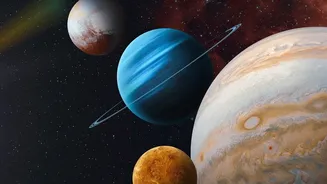
This discovery was made possible by Hubble's Outer Planet Atmospheres Legacy (OPAL) program. Initiated in 2014, OPAL dedicates time each year for the space telescope to create detailed maps of our solar system's gas giants—Jupiter, Saturn, Uranus, and Neptune. This consistent, long-term monitoring allows scientists to track atmospheric changes over time, something crucial for a planet like Saturn where seasons last for over seven Earth years. While amateur astronomers first noted a faint, wavy pattern near the south pole in 2024, it was Hubble’s unparalleled sharpness that confirmed the decagonal shape and traced its origins back to as early as 2023.
A Story of Shifting Seasons
So, why now? The answer appears to lie in Saturn's long, drawn-out seasons. The ringed planet has an axial tilt of about 27 degrees, similar to Earth's, which gives it distinct seasons. However, with an orbit that takes nearly 30 Earth years to complete, each season is a multi-year affair. For over a decade, from roughly 2012 to 2023, Saturn's southern hemisphere was tilted away from Earth, its pole shrouded in winter darkness and hidden from direct view. As the planet's southern spring has progressed, the pole has rotated back into sunlight and our line of sight, revealing the newly formed decagon. This gives scientists a rare opportunity to study how seasonal changes in sunlight and temperature can dramatically reshape a gas giant's atmosphere.
A Tale of Two Poles
The existence of two different polygonal storms on the same planet is a fascinating puzzle. While the northern hexagon has been a stable fixture for decades, this southern decagon is a newcomer that appears to be strengthening. It's not just a surface-level feature; observations show the wave pattern extends deep into multiple layers of Saturn's atmosphere, indicating it's a significant, vertically structured phenomenon. Scientists are now using both Hubble and the James Webb Space Telescope, along with advanced computer models, to understand the dynamics at play. The leading theories involve how jet streams, which are powerful winds circling the planet, can be forced into geometric shapes by other atmospheric waves.