


A Panoramic View of the Cosmos
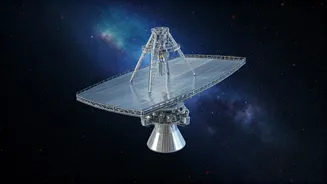
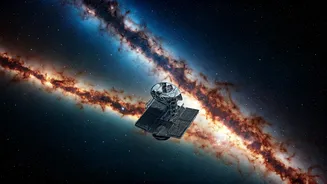
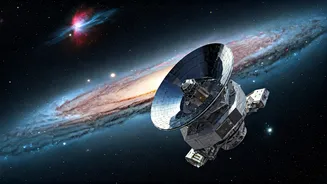
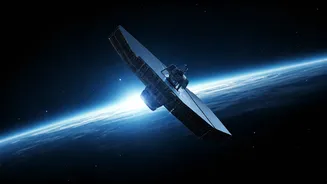
Since the first exoplanets were discovered, telescopes like Hubble and the James Webb Space Telescope (JWST) have given us narrow, deep glimpses into the cosmos, studying individual stars with incredible precision. The Nancy Grace Roman Space Telescope,
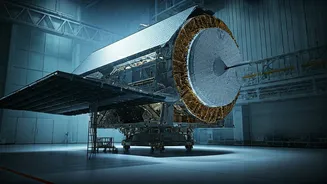
scheduled to launch as early as August 30, 2026, operates on a completely different philosophy. It’s a survey telescope designed for breadth. While its 2.4-meter mirror is the same size as Hubble's, its Wide Field Instrument (WFI) gives it a field of view 100 to 200 times larger. This means that for every one image Hubble takes, Roman can capture a vast cosmic panorama with the same stunning resolution, allowing it to survey the sky up to 1,000 times faster than Hubble. This isn't just an incremental improvement; it's a fundamental shift in how we map the galaxy.
The Power of Gravitational Microlensing
Roman’s real transformative power lies in its primary planet-hunting method: gravitational microlensing. This technique relies on a phenomenon predicted by Einstein, where the gravity of a foreground star acts like a natural magnifying glass, bending and amplifying the light from a more distant, unrelated star that passes behind it. If that foreground star has a planet, the planet’s own gravity creates a second, smaller spike in the background star's brightness. While ground-based telescopes have struggled with this method due to Earth's blurry atmosphere, Roman’s stable perch in space will allow it to monitor hundreds of millions of stars toward the crowded center of our galaxy for these tell-tale flickers. This method is uniquely suited to finding planets that other techniques miss, specifically those farther from their star—in orbits from the habitable zone outwards—and even rogue planets that roam the galaxy untethered to any star.
Conducting a Galactic Planet Census
Previous missions like Kepler were brilliant at finding large planets in tight orbits, but this gave us a somewhat skewed sample. Roman will change the game by conducting a true galactic census. By using microlensing, it’s expected to find over a thousand planets, including analogs to nearly every planet in our solar system, from rocky worlds just a few times the mass of the Moon to ice giants like Neptune. In addition, by simply monitoring the brightness of so many stars, Roman will also detect an estimated 100,000 planets using the more traditional transit method, where a planet periodically dims its star's light by passing in front of it. Combining these two methods will provide an unprecedented statistical understanding of planetary demographics, answering key questions about how common different types of planetary systems are across the galaxy.
A New Way to See Planets Directly
Beyond just detecting their presence, Roman carries a groundbreaking piece of technology called the Coronagraph Instrument. This instrument is a technology demonstrator designed to block the overwhelming glare of a host star, much like holding your hand up to block the sun. This will allow Roman to directly image large, Jupiter-like planets orbiting nearby stars and even analyze the light from their atmospheres, a feat up to a thousand times better than what's possible with current observatories. While it’s mainly a test for future, even more powerful telescopes, the coronagraph will provide our first direct images and spectra of planets similar to our own gas giants, paving the way for one day imaging Earth-like worlds.
A Complementary Partner to Webb
Roman is not a replacement for the James Webb Space Telescope, but a powerful partner. Think of Roman as the scout and Webb as the master detective. Roman's wide-angle surveys will create vast maps of the cosmos, identifying tens of thousands of scientifically interesting targets—from strange new planets to distant galaxies. Webb, with its more powerful but narrower vision, can then perform deep, focused follow-up observations on the most promising discoveries Roman makes. For example, Roman might create a statistical map of thousands of exoplanet atmospheres, while Webb could then study a select few in exquisite chemical detail. Together, their different but complementary strengths will give us the most complete picture of the universe we’ve ever had.