




The Challenge With Radio Waves
For decades, space exploration has relied on radio frequency (RF) systems to communicate with spacecraft. Think of it as the dial-up internet of the solar system. While reliable, RF technology has significant bandwidth limitations. As scientific instruments
become more sophisticated, capturing vast amounts of data like high-resolution images and 4K videos, the radio wave pipeline has become a bottleneck. Transmitting a complete, detailed map of a planet like Mars using traditional RF systems could take weeks or even months. This slow data rate hampers scientific discovery and makes real-time communication for future crewed missions, such as those to Mars, nearly impossible.
A Breakthrough in a Beam of Light
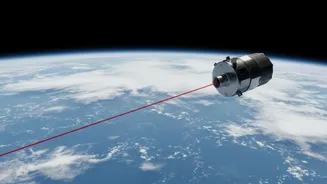
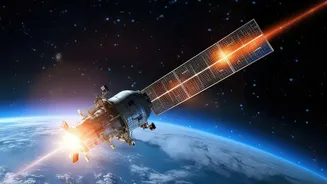
Enter the world of optical communications. Instead of radio waves, this technology uses lasers—specifically, invisible near-infrared light—to carry information across space. The core idea is simple: because infrared light has a much higher frequency than radio waves, it can carry significantly more data in each transmission. This is the difference between a garden hose and a fire hose. NASA's Deep Space Optical Communications (DSOC) experiment was designed to prove this technology could work across the vast distances of our solar system. The goal was to increase data transmission rates by 10 to 100 times compared to the best RF systems currently in use.
The Cat Video Seen Across the Cosmos
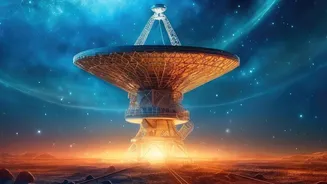
In a milestone demonstration, the DSOC system, hitching a ride on the Psyche spacecraft, streamed the first-ever ultra-high-definition video from deep space. The 15-second clip featured a charming orange tabby cat named Taters chasing a laser pointer. This wasn't just a whimsical choice; it was a nod to early television test broadcasts that often featured images of Felix the Cat. The video was beamed from the Psyche spacecraft when it was nearly 19 million miles (31 million kilometers) from Earth. It took just 101 seconds for the laser signal to travel that immense distance, arriving at the Hale Telescope at Caltech's Palomar Observatory in California. The transmission achieved a maximum data rate of 267 megabits per second (Mbps), a speed comparable to many terrestrial broadband internet connections.
Precision Pointing on a Cosmic Scale
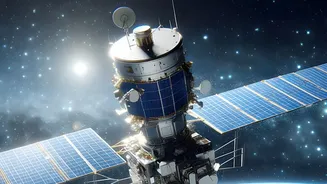
Transmitting a laser beam across millions of miles and hitting a target is an incredible feat of precision. The system involves a flight laser transceiver on the spacecraft that beams the encoded near-infrared laser towards Earth. On the ground, powerful telescopes equipped with specialized detectors are needed to receive the faint signal. The pointing accuracy required is immense, equivalent to a person in Los Angeles aiming a laser pointer and successfully hitting a dime in San Francisco. This precision must be maintained even as both the spacecraft and Earth are constantly in motion. The system has proven its capabilities, establishing links from even greater distances, including a successful test at 140 million miles.
Why This Changes Everything for Space Exploration
The success of DSOC marks the dawn of a new era for interplanetary communication. The ability to transmit massive amounts of data quickly will allow scientists to receive more complex and detailed information from robotic missions, accelerating the pace of discovery. Perhaps most importantly, this technology is a critical enabler for future human exploration. Astronauts on a mission to Mars will need robust, high-bandwidth communication to stream live video, exchange large data files, and communicate in real-time with mission control on Earth. Laser communications will provide that vital link, making humanity's next giant leaps into the solar system safer and more connected. The technology is also more efficient, requiring less mass, volume, and power on spacecraft compared to radio systems.