

An Iconic and Enduring Storm
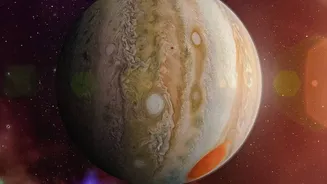
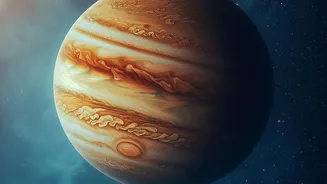
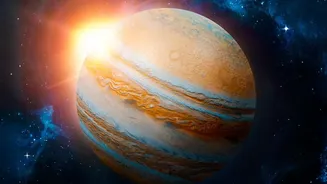
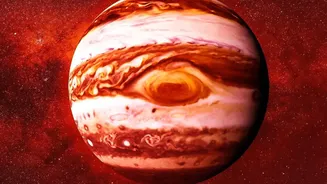
For at least 300 years, astronomers have tracked a colossal, churning storm in Jupiter's southern hemisphere. Known as the Great Red Spot, this anticyclone is a high-pressure system so vast it could once swallow three Earths. With wind speeds reaching
hundreds of kilometres per hour, it stands as the most powerful and persistent storm in our solar system. Unlike hurricanes on Earth, which are born from warm oceans and fade in days, the Great Red Spot is a near-permanent feature, powered by Jupiter's internal heat and complex atmospheric dynamics. Its distinctive reddish-orange hue, the precise cause of which is still debated by scientists, makes it an unmistakable feature of the gas giant.
A Storm Within a Storm
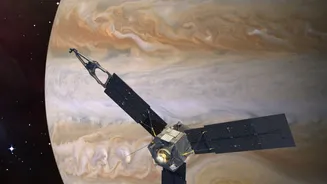
While the Great Red Spot itself is a single massive vortex, it is not a uniform entity. Observations from powerful instruments like the Hubble Space Telescope and NASA's Juno spacecraft have revealed a complex internal structure. Within the main storm, smaller vortices—often described as 'cosmic tornados'—swirl and churn. These eddies are not just passive features; they are believed to play a crucial role in the overall dynamics and energy of the Great Red Spot. Scientists have hypothesized that these smaller storms feed into the larger system, influencing its momentum and stability. Recent observations have also uncovered dark features within the storm that were found to be holes in the planet's cloud layers, allowing us to peer deeper into the turbulent atmosphere.
Signs of an Unexplained Shrinkage
The headline news for decades has been that the Great Red Spot is shrinking. What was once measured at over 40,000 kilometres across in the late 1800s had shrunk to about 16,500 kilometres in the 2010s. This shrinking trend appears to have accelerated since 2012, with the storm losing nearly 1,000 kilometres of its width per year at times. The latest captures examined by scientists now focus on the behaviour of the smaller 'tornados' within the spot. The prevailing theory is that a change in the activity of these smaller eddies could be directly responsible for the accelerated downsizing of the main storm. It seems these internal vortices, which may act as a power source, are themselves changing, potentially being sapped of momentum.
Why is This Happening?
The driving question for planetary scientists is what is causing this change. One leading hypothesis suggests that the Great Red Spot is shrinking because its 'diet' is changing. The storm may be failing to consume as many smaller storms as it used to, or the nature of these eddies feeding into it is altering its internal dynamics. As the storm contracts horizontally, some data suggests it may be stretching vertically, becoming taller. The Juno mission, which has flown directly over the storm, revealed that its roots penetrate deep into the planet's atmosphere—as far as 500 kilometres below the cloud tops. Understanding how this deep structure is connected to the shrinking visible storm is a key area of current research. The changes suggest that the long-term stability of this ancient storm might be more fragile than once thought.
What This Means for Planetary Science
Studying the evolution of the Great Red Spot is more than just a celestial weather report. It provides a unique, real-world laboratory for understanding the physics of planetary atmospheres. The dynamics at play on Jupiter—a gas giant with no solid surface to slow storms down—help scientists model weather on a massive scale. These insights can be applied to understanding other gas giants in our solar system, like Saturn with its own massive storms, and even to the thousands of 'hot Jupiters' discovered orbiting distant stars. Each new observation brings us closer to solving the mysteries of how these giant storms form, what sustains them for centuries, and what will eventually cause them to fade away. For now, the Great Red Spot continues to surprise us, proving that even the most familiar cosmic landmarks still hold deep secrets.