



The Solar System's Frigid Attic
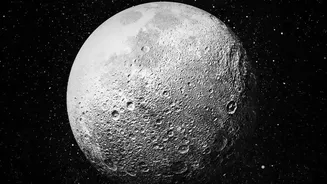
Think of the Kuiper Belt as the solar system's vast, frozen attic. Located beyond the orbit of Neptune, it's a donut-shaped region filled with millions of icy bodies—remnants from the formation of our planetary neighbourhood some 4.5 billion years ago.
These objects, which include dwarf planets like Pluto, are considered pristine time capsules because they have been largely untouched by the heat and chemical processing that occurred closer to the Sun. For scientists, studying these objects is like getting a direct look at the raw ingredients that built our world. However, sending probes to visit these distant bodies is incredibly difficult. That's why scientists have turned to an ingenious alternative: studying the dust these objects shed as it makes its long journey toward Earth.
Catching Stardust from the Stratosphere
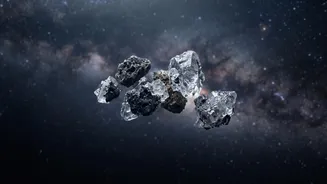
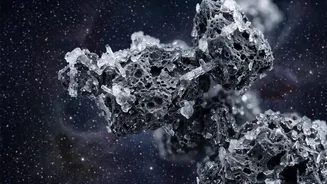
The latest findings didn't come from a spacecraft in deep space but from right here at home. A team of scientists, led by planetary scientist Lindsay Keller of NASA's Johnson Space Center, analysed a collection of just twelve microscopic dust grains. These particles were collected from Earth's upper stratosphere, where they drifted after an epic journey from the solar system's edge. Scientists could confirm their distant origin by examining the 'scars' left on them by solar radiation. The dust grains had about 100 times more radiation track damage than dust from the closer asteroid belt, indicating they had spent a much longer time travelling through space—long enough to have come from the Kuiper Belt.
A Chemical Fingerprint of Ancient Water
Under powerful electron microscopes, the tiny dust grains revealed something extraordinary. They contained minerals like saponite and serpentine, which are types of clays that only form when liquid water interacts with rock. This means that billions of years ago, the parent bodies from which this dust originated must have had liquid water inside them. While the Kuiper Belt is frozen solid today, heat from radioactive decay or major collisions in the early solar system could have melted interior ice, creating temporary internal oceans. The water itself is long gone, but the minerals it created preserved a crucial clue: a unique 'heavy' oxygen signature. This told scientists that the water in the Kuiper Belt came from a reservoir that was chemically distinct and isolated from the water found closer to the Sun.
Why This Discovery Matters
This discovery is more than just a cosmic curiosity; it provides compelling evidence for a long-held theory that a vast reservoir of 'heavy' water existed in the outer solar system. The finding suggests that the building blocks for life—water and carbon, which was also abundant in the dust grains—were present at the solar system's fringes. This separate, pristine reservoir remained largely cut off from the churning chaos of the inner solar system, possibly due to the gravitational influence of giant planets like Jupiter. For a long time, scientists have debated whether Earth's water arrived from comets or asteroids. This study adds a new possibility to the mix: that some of our planet's water may have arrived as tiny dust particles that spiralled in from the most distant reaches of our solar system, carrying the life-giving liquid locked within their mineral structures.
New Horizons and the Expanding Frontier
This dust-based discovery complements ongoing work by NASA's New Horizons spacecraft, which is currently journeying through the Kuiper Belt. The probe, which famously flew by Pluto in 2015 and the object Arrokoth in 2019, has been detecting more dust than models predicted, suggesting the Kuiper Belt might be much larger than previously thought, or that there could even be a second belt. Each new finding, whether from dust collected in our atmosphere or data beamed back from a spacecraft billions of kilometres away, helps piece together the grand puzzle of how our solar system formed and how a rocky planet like Earth became the blue, water-covered world we know today.