

A New Window on Cosmic Dawn
To see the universe's first galaxies, you need a special kind of observatory. Because the universe is expanding, the light from these incredibly distant objects is stretched into longer, redder wavelengths as it travels across billions of light-years.
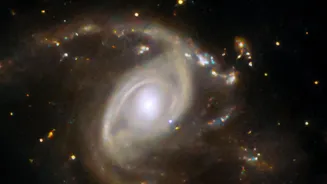
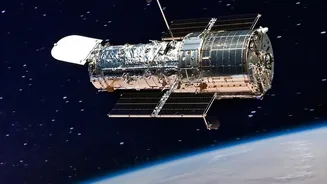
The James Webb Space Telescope (JWST) was designed specifically to capture this infrared light, allowing it to see objects more than 13.5 billion years in the past. This capability provides an unprecedented view into what astronomers call the 'cosmic dawn'—the era when the very first stars and galaxies lit up the darkness after the Big Bang. Unlike its predecessor, the Hubble Space Telescope, Webb's giant mirror and advanced instruments give it the sensitivity to spot faint, ancient structures that were previously invisible, offering a much clearer picture of how everything we see today began.
Galaxies That Grew Up Too Fast
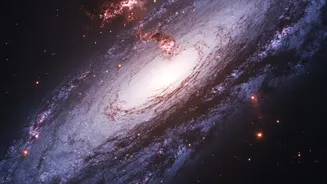
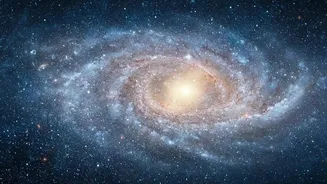
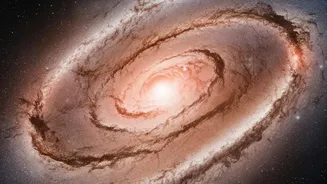
One of the most startling discoveries from Webb's high-resolution views is the existence of massive, well-structured galaxies that formed surprisingly early in cosmic history. Standard cosmological models predicted that the first galaxies would be small, clumpy, and chaotic, gradually merging and growing over billions of years. Instead, Webb has found multiple galaxy candidates that appear enormous and mature just 500 to 700 million years after the Big Bang. One was even estimated to be more massive than our own Milky Way, a galaxy that had billions of more years to develop. These findings, dubbed "universe breakers" by some, challenge the timeline of galaxy formation. For these galaxies to get so big so fast, they would have had to convert nearly all of their available gas into stars with an efficiency that theories did not predict was possible.
The Puzzle of Ancient Black Holes
It’s not just the galaxies that are surprisingly large; it's what lurks at their centers. Webb is spotting supermassive black holes in the early universe that are far too big for their age. According to established theories, black holes need time to grow, starting from the remnants of massive stars and slowly accreting matter. Yet Webb has found black holes billions of times the mass of our sun from an era when the universe was less than a billion years old. This finding has forced theorists to consider more exotic formation scenarios. Perhaps massive black holes could form directly from the collapse of gigantic gas clouds, or they grew at super-charged rates, gobbling matter much faster than previously thought. Another intriguing mystery is the discovery of numerous "Little Red Dots," which could be a new type of object entirely—perhaps early black holes shrouded in dense cocoons of gas.
Rewriting the Chemical Story
By analyzing the light from these remote galaxies, a process called spectroscopy, scientists can read their chemical fingerprints. These studies are revealing that the chemical environment of the early universe was more complex and varied than expected. Webb has detected elements like oxygen, nitrogen, and sulfur in galaxies shining when the cosmos was just a fraction of its current age. The presence of these heavier elements, which are forged inside stars and scattered by supernova explosions, indicates that multiple generations of stars had already lived and died very early on. This suggests that the cycle of star birth and death—the engine of cosmic evolution—was running much faster and more furiously than models had anticipated. These chemical clues are fundamental to piecing together how the first stars transformed the universe from a simple soup of hydrogen and helium into the rich, complex cosmos we inhabit today.