

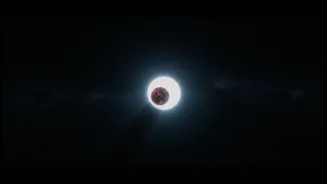


The Survivor Planet and Its Stellar Ghost
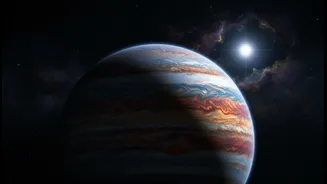
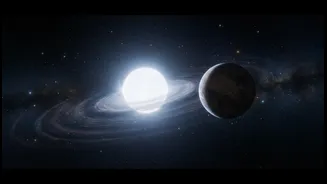
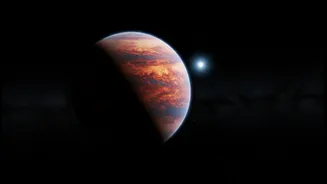
Imagine a planet the size of Jupiter orbiting a star that’s only the size of Earth. Now, imagine that planet is seven times wider than its own sun. This isn't science fiction; it's the bizarre reality of a system located 80 light-years away. Astronomers
are captivated by a gas giant planet, named WD 1856 b, which circles its star's dead core once every 34 hours. It orbits fifty times closer than Earth orbits our Sun. This setup is so strange that it should not exist, presenting a cosmic puzzle that has baffled scientists since the planet's initial discovery in 2020.
The Final Act of a Sun-Like Star
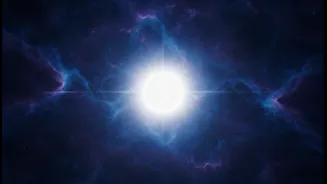
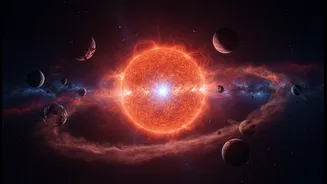
To understand why this planet is so perplexing, we first need to talk about its host: a white dwarf. A white dwarf is the stellar remnant left behind when a low- or medium-mass star, like our own Sun, runs out of nuclear fuel. In its final throes, the star swells into a red giant, expanding so much that it engulfs and destroys any nearby planets. After shedding its outer layers, all that remains is a super-dense, Earth-sized core that slowly cools over billions of years. These 'dead' stars were often seen as the quiet endnotes of a star's life, cosmic graveyards where nothing much happens.
A Cosmic Whodunnit
The existence of WD 1856 b presented a major contradiction. Given its current, incredibly tight orbit, the planet should have been vaporized when its star became a red giant billions of years ago. So how did it survive? And how did it end up in an orbit that should have been a death sentence? For years, astronomers had theories but no firm evidence. Solving this mystery required a tool powerful enough to peek into the faint environment of a dead star and analyze the atmosphere of a planet that was never supposed to be there.
Webb Delivers the Decisive Clues
This is where NASA's James Webb Space Telescope (JWST) stepped in. By observing the planet as it passed in front of its tiny star, Webb was able to do something remarkable: detect the chemical makeup of its atmosphere and measure its temperature. The results were stunning. Webb found the telltale signatures of hydrocarbons, most likely methane, marking the first time an atmosphere has been detected on a planet orbiting a white dwarf. But the biggest clue was the planet's temperature. It was found to be around 126 degrees Celsius—significantly warmer than it should be if only heated by the faint glow of its dead star.
The Great Migration
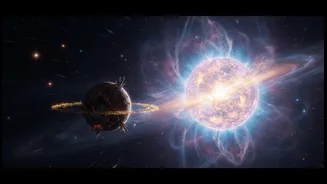
This unexpected warmth was the key that unlocked the entire mystery. The planet didn't survive in its current orbit; it moved there. Scientists now believe that WD 1856 b originally formed much farther away from its star, safe from the red giant phase. Then, over billions of years, a gravitational nudge—likely from two other companion stars in the same system—sent it spiraling inward. As the planet migrated closer to the massive white dwarf, intense gravitational forces squeezed and flexed it, generating immense heat in its interior. The warmth Webb detects today is the leftover energy from that violent journey, slowly radiating away.
A Glimpse into Our Solar System's Future
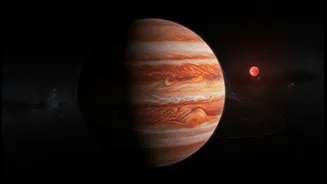
This discovery does more than just solve one planetary puzzle; it gives us a preview of our own solar system's distant future. In about five billion years, our Sun will also become a white dwarf. While Mercury and Venus will be destroyed, this study suggests that outer planets like Jupiter and Saturn could survive. They might even be pushed into new, strange orbits around the Sun's cooling embers. Thanks to Webb, white dwarfs are no longer just fascinating relics. They are hosts to dynamic, evolving systems and a potential window into the second life of planets long after their stars have died.