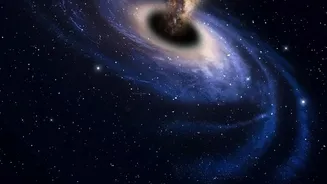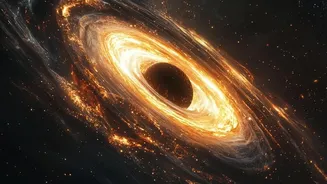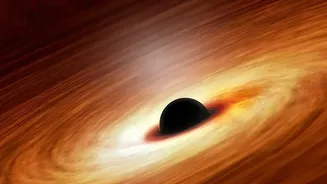





For decades, one of the biggest questions in science has been 'What is dark matter?'. A new report has cast serious doubt on one elegant answer: that it's all made of massive, ancient black holes left over from the dawn of the universe.
The Universe's Invisible Glue
Imagine everything
you can see: stars, planets, galaxies, and even the dust between them. All of this 'normal' matter makes up only about 5% of the known universe. A staggering 27% is thought to be 'dark matter', an invisible substance that doesn't emit or reflect any light. So how do we know it's there? Gravity. In the 1930s, astronomer Fritz Zwicky noticed that galaxies in clusters were moving so fast they should have flown apart. He concluded some unseen 'glue' must be providing the extra gravitational pull needed to hold them together. This invisible mass appears to act as a cosmic scaffold, shaping how galaxies form and evolve. Without it, our universe would likely be a cold, empty place with no stars or planets.
An Elegant, Ancient Solution
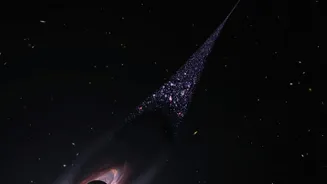
If dark matter is real, what is it made of? For a long time, the leading candidates were hypothetical particles called WIMPs (Weakly Interacting Massive Particles). But after years of searching for them with giant detectors and particle colliders turned up nothing, scientists began to seriously consider other ideas. One of the most compelling alternatives was the Primordial Black Hole, or PBH. These aren't the black holes that form from collapsing stars. Instead, the theory goes, these are ancient black holes that may have formed from dense pockets of matter in the hot, chaotic moments right after the Big Bang. They were an attractive candidate for dark matter because they are, by definition, dark, massive, and interact with the rest of the universe primarily through gravity — just as dark matter seems to do.
The Evidence Piles Up
The headline refers to recent findings that place new, strict limits on whether huge black holes could make up a significant portion of dark matter. One recent study looked for 'stupendously large black holes' — objects billions of times more massive than our sun. The logic was that if these objects made up all the dark matter, their immense gravity would have left a 'grainy' pattern on the cosmic microwave background (CMB), the faint afterglow of the Big Bang. When researchers analysed the CMB, they found it was smooth, not grainy, suggesting these enormous black holes cannot be a major component of dark matter. Other research uses gravitational lensing, where a massive object bends the light from something behind it. By looking for the tell-tale distortions caused by black holes, scientists can constrain how many of them could possibly be hiding out there. So far, these studies have not found enough lensing events to support the idea that most dark matter consists of black holes.
Fewer Places to Hide
This doesn't mean primordial black holes don't exist at all. It just means they are unlikely to be the entire explanation for dark matter. The latest research essentially closes a window of possibility. While some studies hint that certain types of primordial black holes might still contribute a small fraction of the universe's dark matter, the idea of them being the dominant source is now on shaky ground. For example, while stupendously large black holes seem to be ruled out, the possibility of much smaller, asteroid-mass black holes remains harder to disprove. Science works by narrowing down the possibilities, and this new evidence forces physicists to look more critically at other potential dark matter candidates. The mystery hasn't been solved, but one popular chapter may be drawing to a close.
So, What Is It Then?
With the primordial black hole theory looking less likely, where do scientists turn next? The search for particle candidates like WIMPs and another hypothetical particle called the axion continues, even if it has been challenging. Another area of investigation involves entirely new thinking. Some physicists question whether dark matter is a substance at all. Instead, they propose that our theory of gravity itself might be incomplete. These 'modified gravity' theories, often called MOND (Modified Newtonian Dynamics), suggest that gravity behaves differently on a galactic scale than our current laws predict. These ideas face their own challenges in explaining all the cosmic observations that dark matter theory accounts for, but they remain an active area of research. The hunt for one of the universe's biggest secrets is far from over.