




So, What Exactly Is This Fog?
Imagine the universe shortly after the Big Bang. For the first billion years or so, it wasn't the clear, star-filled expanse we see today. Instead, it was filled with a thick, opaque haze of neutral hydrogen gas. This primordial soup acted like a dense
fog, absorbing the energetic ultraviolet (UV) light from the very first stars and galaxies. Astronomers call this period the 'Era of Reionization'—a cosmic transformation when this fog was gradually cleared, allowing light to travel freely across the cosmos for the first time. For decades, the big question has been: what, or who, was powerful enough to burn off this fog and turn the lights on in the universe?
The Tiny Galaxy Causing a Big Stir
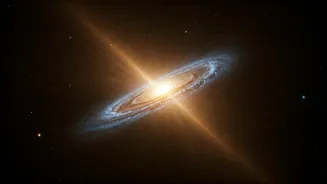
The main character in this cosmic drama is a galaxy with the not-so-catchy name of MXDFz4.4. Think of it as the David to the universe's Goliath. Observed as it was just 1.4 billion years after the Big Bang, this galaxy is a hundred times smaller than our own Milky Way. But don't let its size fool you; it's a celestial powerhouse. MXDFz4.4 is churning out new stars at a rate roughly ten times higher than our home galaxy. This frantic pace of star formation, known as a 'starburst,' packs an incredible number of hot, massive, young stars into an exceptionally compact space, creating a beacon of intense energy in the dark, early universe.
A Discovery Considered Impossible
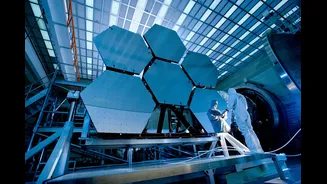
Here’s where the story gets wild. Using the combined power of the Hubble Space Telescope, the James Webb Space Telescope, and the Very Large Telescope, astronomers detected something revolutionary: ionizing UV light escaping from MXDFz4.4 and traveling all the way to us. This is the scientific equivalent of seeing a candle flame from hundreds of kilometers away through a thick fog. It simply wasn't supposed to be possible. The prevailing wisdom was that the dense cosmic fog surrounding the galaxy would have completely absorbed this type of light, making it invisible to our telescopes. Ilias Goovaerts, the lead author of the study, noted that observing a galaxy like this was "thought to be impossible." It’s the first time such light has been directly detected from a galaxy this deep into the reionization era.
Why Scientists Are Spamming the Chat
This discovery is more than just a cool picture; it's a long-sought 'smoking gun.' It provides the first direct, observational evidence for how the cosmic fog was cleared. The theory has long been that small, hyperactive galaxies like MXDFz4.4 were the primary engines of reionization. Their intense UV radiation, combined with the explosive energy from dying stars (supernovas), was powerful enough to punch holes in the surrounding hydrogen fog, like millions of tiny blowtorches clearing a path for light. Now, scientists don't just have a model; they have a direct observation of the process in action. It helps solve a fundamental mystery about our cosmic origins and confirms that these small but mighty galaxies played an outsized role in shaping the transparent universe we inhabit today.