


What is CAPSTONE?
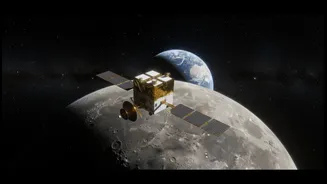
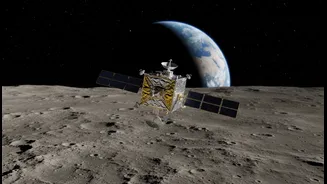
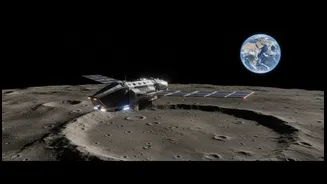
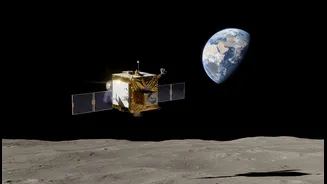
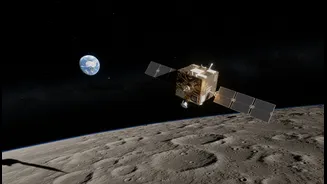
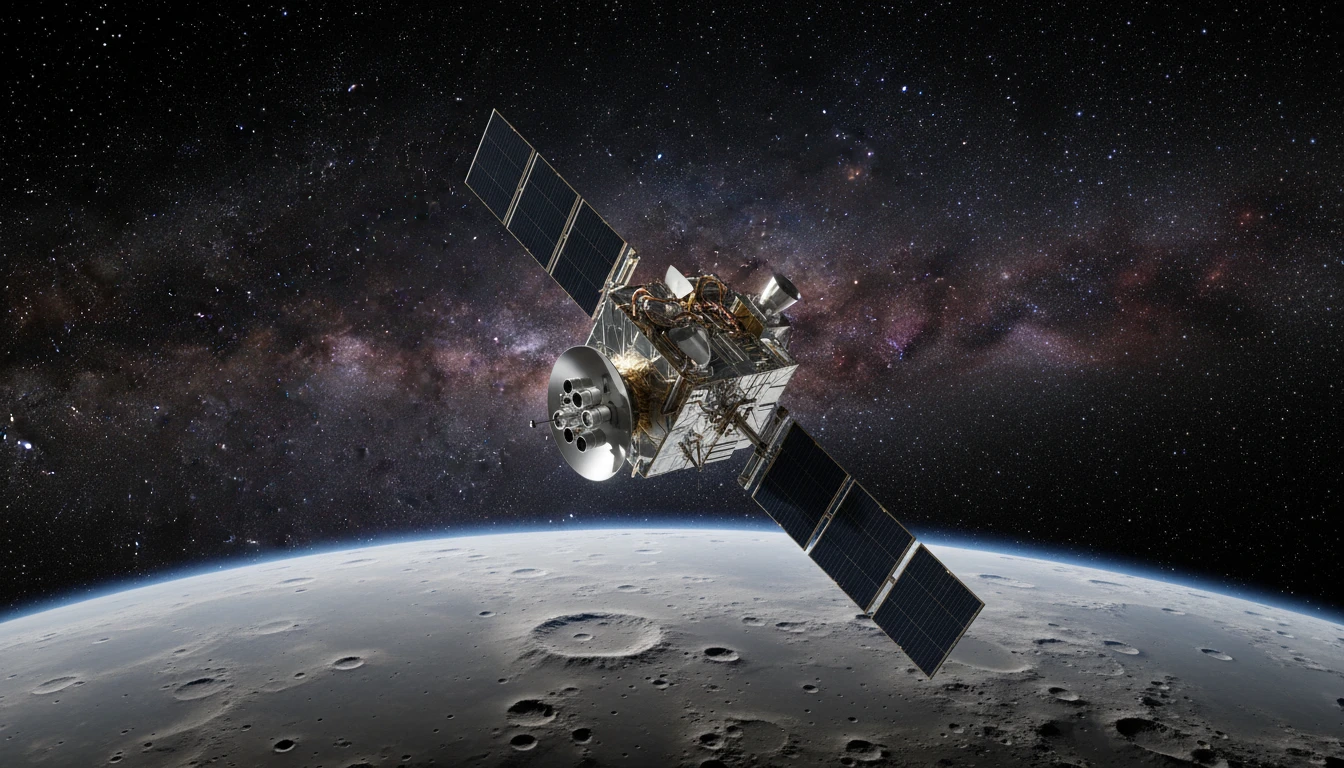
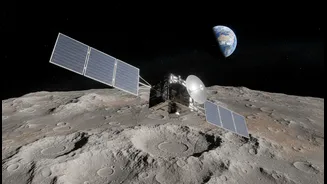
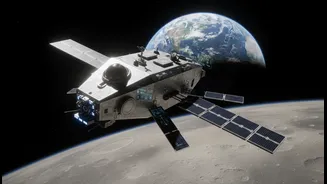
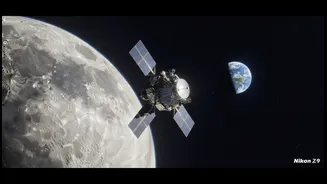
CAPSTONE, which stands for Cislunar Autonomous Positioning System Technology Operations and Navigation Experiment, is a 55-pound CubeSat launched in June 2022. Owned and operated by the commercial company Advanced Space for NASA, its primary goal was
to test a unique and highly ambitious orbit around the Moon. Unlike the large, powerful, and expensive probes of the past, CAPSTONE was designed to be a low-cost, rapid mission to validate critical technologies, representing a new, more agile way of conducting deep-space exploration through commercial partnerships. Its success demonstrates that small, relatively inexpensive satellites can perform complex tasks far from Earth, a significant shift in the business of space.
A Groundbreaking Lunar Orbit
At the heart of the mission is the orbit itself: a near-rectilinear halo orbit (NRHO). This highly elliptical path is located at a precise gravitational balance point between the Earth and the Moon. Think of it as a remarkably stable and fuel-efficient parking spot in space. A spacecraft in an NRHO requires minimal energy to stay in orbit. The path takes CAPSTONE as close as 1,600 kilometers to one lunar pole and as far as 70,000 kilometers from the other. Before CAPSTONE, this orbit had only been simulated on computers; CAPSTONE was the first spacecraft to actually fly in it, proving its stability and viability for long-term missions.
Paving the Way for the Lunar Gateway
The reason this specific orbit is so important is because it is the planned home for the Lunar Gateway, a key component of NASA's Artemis program. The Gateway will be a small space station in orbit around the Moon, serving as a command center, science lab, and short-term habitat for astronauts. It will be a staging post for missions to the lunar surface and, eventually, Mars. By successfully operating in the NRHO for an extended period, CAPSTONE has drastically reduced the risk for the much larger and more complex Gateway. It has provided invaluable real-world data on the orbit's characteristics, power requirements, and propulsion needs, essentially acting as a scout for the human missions to follow.
A New GPS for the Moon
Beyond testing the orbit, CAPSTONE had another critical job: demonstrating a new navigation system. The mission tested the Cislunar Autonomous Positioning System (CAPS), which allows spacecraft to determine their position relative to other spacecraft without constantly relying on signals from Earth. CAPSTONE successfully performed communications tests with NASA’s Lunar Reconnaissance Orbiter (LRO) to demonstrate this peer-to-peer navigation capability. As the cislunar environment becomes more crowded, this technology will be essential for managing traffic and enabling autonomous operations, much like a GPS for the Moon. The mission's success has rapidly increased the technology's readiness for wider adoption.
A Resilient and Efficient Pioneer
The mission wasn't without challenges. Shortly after launch, CAPSTONE experienced communications issues and a problem that caused it to lose attitude control, but engineers on the ground managed to diagnose and fix the issues, showcasing the mission's resilience. The spacecraft's journey to the Moon also used a highly efficient, low-energy ballistic lunar transfer, which took four months but saved a significant amount of propellant, making the mission possible for a small CubeSat. Having achieved all of its primary and extended mission objectives by mid-2026, NASA has concluded its activities, but the spacecraft will continue to be operated by Advanced Space, serving as a testbed for future technologies. This model—using a small, commercial satellite to test cutting-edge software and hardware in deep space—is a paradigm shift for the industry.