

The 'Eye of God' in Unprecedented Detail
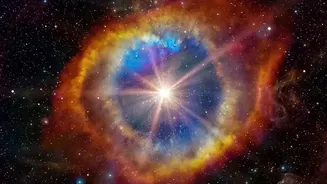
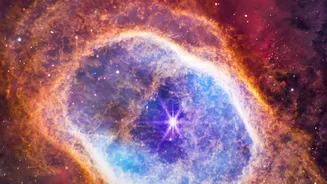
For nearly two centuries, astronomers have been captivated by the Helix Nebula, one of the closest and most striking examples of a planetary nebula. Its resemblance to a giant eye staring across the cosmos has earned it the nickname the "Eye of God."
It’s the glowing, expanding shell of gas shed by a star in its final evolutionary stages. While powerful observatories like the Hubble Space Telescope have provided stunning images before, Webb's advanced infrared instruments cut through the cosmic dust to reveal the nebula's structure with breathtaking clarity. What was once seen as soft and ethereal is now resolved into a complex tapestry of filaments, knots, and interacting layers of gas.
Peeling Back the Gaseous Layers
The latest images from Webb's Near-Infrared Camera (NIRCam) zoom in on the inner edge of the nebula's main ring. Here, the telescope has unveiled thousands of previously unseen structures that astronomers call "cometary knots." These aren't actual comets, but dense, tadpole-shaped globules of gas and dust. Each one is immense—many are larger than our entire solar system—and they trail long tails away from the nebula's center. These features form as blistering, fast-moving winds from the hot central star slam into cooler, slower-moving gas that the star ejected thousands of years earlier. The collision fragments the material, creating a beautifully chaotic and textured scene that chronicles the star's violent, drawn-out death.
A Cosmic Detective Story
These newly revealed layers tell a story. The different colors in Webb's infrared image represent a stark transition in temperature. Hotter, ionized gas glows fiercely near the central star's intense radiation, while cooler molecular hydrogen exists further out. The comet-like knots are so dense that they shield gas and dust within them, creating protected pockets where more complex molecules can survive and form. By studying how these different layers of material interact, scientists can better understand the physics of this process. The images provide crucial data on how a dying star recycles its material, enriching the interstellar medium with the heavy elements necessary to form the next generation of stars and planets. It’s a fundamental part of the cosmic life cycle, captured in action.
Glimpsing the Sun's Distant Future
Beyond its sheer beauty, the Helix Nebula serves as a preview of our own solar system's eventual fate. The star at its center was once similar to our Sun. After exhausting the fuel in its core, it swelled into a red giant and began puffing its outer layers into space. What remains is a tiny, incredibly hot and dense white dwarf. In about five billion years, our Sun will undergo the same transformation, creating its own planetary nebula. Studying the Helix Nebula with Webb's power is therefore like looking into a crystal ball. It allows scientists to witness, in extraordinary detail, the processes that will one day sculpt the end of our own solar system, breaking it apart and returning its materials to the galaxy.