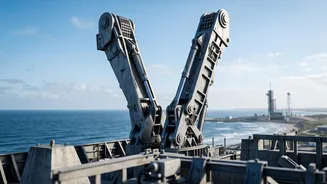







The 'Mechazilla' Catch
At the heart of SpaceX's strategy is the launch and integration tower, nicknamed 'Mechazilla'. Standing nearly 400 feet tall, this structure is equipped with two massive, powerful mechanical arms often called 'chopsticks'. Their job is not just to stack
the Starship vehicle on top of its Super Heavy booster before launch, but to perform the far more daunting task of catching the 233-foot-tall booster as it returns from the edge of space. The first successful catch of a Super Heavy booster occurred on October 13, 2024, a moment described by commentators as a day for the engineering history books. This method is a complete departure from the landing legs used by the company's workhorse Falcon 9 rocket.
The Need for Speed and Efficiency
The primary driver for this complex catch system is SpaceX's ultimate goal: rapid and complete reusability. To achieve founder Elon Musk's vision of colonizing Mars, Starship needs to fly frequently, reliably, and cheaply—more like an airliner than a traditional rocket. Landing legs, like those on the Falcon 9, add significant weight and require refurbishment after landing. By removing them, the booster's mass is reduced, which can translate to carrying heavier payloads. Catching the booster directly at the launch tower eliminates the need to transport it from a landing zone or a droneship at sea, drastically cutting down the turnaround time. The goal is to inspect, refuel, and relaunch the same booster, potentially multiple times a day.
Anatomy of a Controlled Descent
Catching a 22-storey building falling from the sky requires almost unbelievable precision. The entire maneuver depends on the booster executing a perfectly controlled autonomous descent. After separating from the Starship upper stage, the Super Heavy booster performs a series of engine burns to reverse its course and target the launch site. It uses four large, grid-like fins at its top to steer itself with immense precision as it plummets through the atmosphere at supersonic speeds. In the final moments of the descent, a number of its Raptor engines reignite, slowing the massive vehicle from over 1,000 km/h to a near-hover just as it arrives between the tower's open arms. The onboard flight computers must guide the booster to a precise point in space where the 'chopsticks' can securely close around its reinforced hard points.
The Razor's Edge of Failure
The stakes are astronomically high. Before committing to a catch attempt, SpaceX verifies that thousands of vehicle and ground system criteria are met. If any of these checks fail, the booster is programmed to divert and perform a soft splashdown in the Gulf of Mexico. A miscalculation in the final approach, a sudden gust of wind, or a malfunction in the tower's hydraulic arms could lead to a catastrophic failure, destroying both the booster and the launch tower that is essential for all Starship operations. The system's control logic uses real-time data from LiDAR and high-resolution cameras, combined with machine learning algorithms, to track the booster and adjust the arms, but the margin for error is measured in centimeters.
From Theory to Reality
After achieving the first successful booster catch in late 2024, SpaceX has continued to push the envelope. The company has now successfully caught the Super Heavy booster several times, proving the concept is viable. The next monumental step is to attempt the same feat with the Starship upper stage, which returns from orbit at much higher velocities and presents a different set of aerodynamic and thermal challenges. According to recent statements from Elon Musk, SpaceX plans to attempt the first-ever catch of the Starship upper stage on its upcoming 15th flight. Successfully recovering both the booster and the ship will mark the first time an orbital-class rocket has been made fully and rapidly reusable, a milestone critical for deploying the next generation of Starlink satellites and for NASA's Artemis missions to the Moon.