


The Sun’s Constant, Gusty Breath
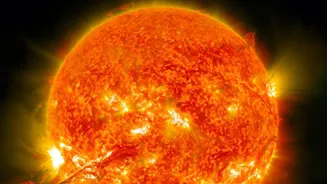
The sun constantly releases a stream of charged particles—mostly high-energy protons and electrons—into space. This isn't a gentle breeze; it's a supersonic flow called the solar wind, which travels throughout our entire solar system. These winds aren't
uniform. They come in fast and slow streams, and powerful solar events like Coronal Mass Ejections (CMEs) can create intense gusts. These fluctuations are the core of 'space weather,' and they have real-world consequences on Earth. They can trigger beautiful auroras, but also disrupt satellite communications, interfere with GPS signals, and even damage power grids on the ground. Understanding these speed variations is crucial for forecasting space weather and protecting our technology.
The Perfect Perch at Lagrange Point 1
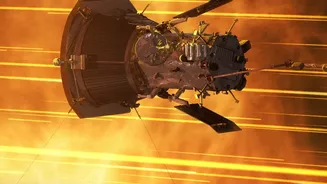
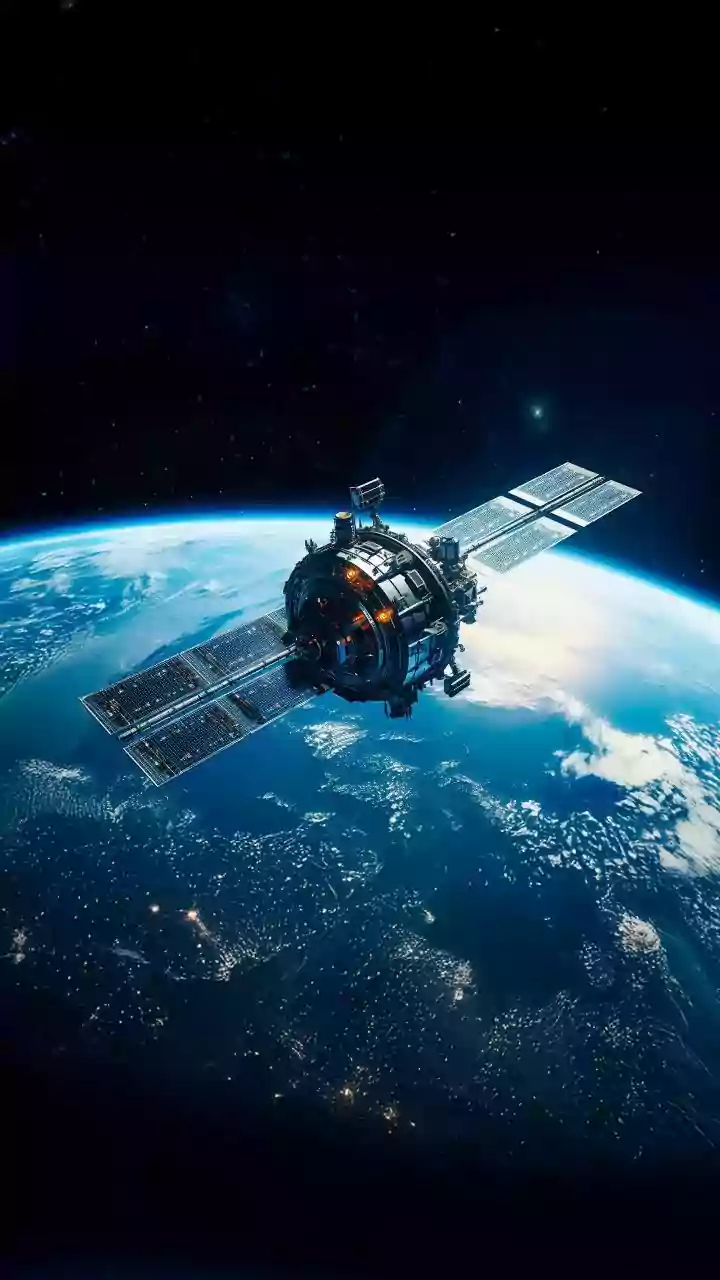
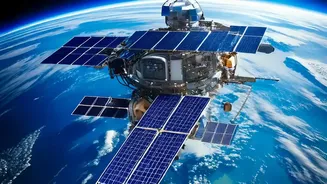
To measure the solar wind before it reaches Earth, you need an unobstructed view. Aditya-L1 is positioned at a special spot in space called Lagrange Point 1 (L1), about 1.5 million kilometres from Earth. At this unique point, the gravitational pulls of the Sun and Earth balance out, allowing the spacecraft to essentially hover in place with minimal fuel. This location gives Aditya-L1 a continuous, uninterrupted view of the Sun and the solar wind flowing towards us, far from the interference of Earth's magnetic field. It acts as an early warning outpost, giving us vital lead time on incoming solar disturbances.
The Dynamic Duo: ASPEX and PAPA
Aditya-L1 uses two primary instrument suites to 'catch' and analyse solar wind particles: ASPEX (Aditya Solar wind Particle EXperiment) and PAPA (Plasma Analyser Package for Aditya). Think of them as a highly sophisticated cosmic weather station. ASPEX has two components: the Solar Wind Ion Spectrometer (SWIS) to measure lower-energy particles like protons and alpha particles, and the Supra Thermal Energetic Particle Spectrometer (STEPS) to study higher-energy particles. SWIS uses sensors with a 360-degree field of view to capture a complete picture of the incoming ions, measuring their energy and direction.
How They 'Clock' a Particle's Speed
The PAPA instrument complements ASPEX by focusing on the composition, temperature, and velocity of the solar wind. It also has two sensors: the Solar Wind Electron Energy Probe (SWEEP) for electrons, and the Solar Wind Ion Composition Analyser (SWICAR) for ions. These instruments work like a particle trap. As solar wind particles fly into the sensors, the instruments measure their energy levels. By analysing how much energy a particle has and what direction it came from, scientists can precisely calculate its speed. The sensors are designed to distinguish between different types of particles, like protons, electrons, and heavier ions, and measure their individual properties. This helps create a detailed profile of the solar wind at any given moment.
From Raw Data to Crucial Forecasts
By continuously gathering this data, Aditya-L1 builds a dynamic map of the solar wind's behaviour. It can detect the tell-tale signs of an approaching CME, such as a change in the ratio of alpha particles to protons. These signatures are critical for space weather forecasting. The data from ASPEX and PAPA, combined with observations from the spacecraft's magnetometer which measures the interplanetary magnetic field, provides a comprehensive understanding of solar events. This knowledge is not just academic; it helps protect our multi-billion dollar satellite infrastructure, ensures the stability of our power grids, and safeguards astronauts in space. The mission's findings allow scientists to refine models of space weather, moving us closer to reliable flare forecasting and a safer, more connected world.