

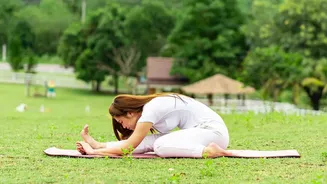
In our search for daily wellness, some of the most effective tools are the simplest. Apanasana, also known as the Knees-to-Chest pose, is a gentle and accessible yoga posture perfect for beginners and seasoned practitioners alike.
What is Apanasana?
Apanasana is a foundational
supine yoga pose that involves lying on your back and hugging your knees toward your chest. Its Sanskrit name offers a clue to its primary function: 'Apana' refers to the body's downward-flowing life force energy, which governs elimination and release, while 'Asana' means pose. Therefore, Apanasana is often called the 'Wind-Relieving Pose' or the 'Pose of Downward-Moving Energy'. It is a restorative posture frequently used at the beginning of a yoga class to gently warm up the body or at the end to cool down and release tension.
The Gentle Power of Knees-to-Chest
The benefits of this simple pose are surprisingly vast. Its most celebrated advantage is the relief it provides for lower back pain by gently stretching and decompressing the lumbar spine. The light pressure of the thighs against the abdomen massages the internal organs, which can stimulate digestion and help alleviate issues like gas, bloating, and constipation. On a more subtle level, Apanasana has a profound calming effect on the nervous system. By encouraging deep, steady breathing in a supported position, it can help reduce stress, anxiety, and mild depression, making it an excellent pose to practice before sleep or during moments of overwhelm.
A Step-by-Step Guide for Beginners
Finding comfort in Apanasana is straightforward. Follow these steps to practice it safely:
1. Start on Your Back: Lie down comfortably on a yoga mat or a soft surface. Begin with your legs extended, or for more lower back support, keep your knees bent and feet flat on the floor. Take a moment to relax your shoulders and allow your back to settle into the floor.
2. Draw the Knees In: On an exhale, gently bend your knees and draw them in towards your chest.
3. Hold Comfortably: Clasp your hands around your shins, just below the knees. If this is a strain, you can hold the backs of your thighs instead. The goal is to let your shoulders and the back of your head rest completely on the mat.
4. Breathe and Hold: Keep your chin slightly tucked to lengthen the back of your neck. Hold the pose for anywhere from 30 seconds to a few minutes, breathing deeply and evenly. Avoid holding your breath.
5. Release Gently: To come out of the pose, release your grip on an exhale and slowly lower your feet back to the floor. Extend your legs and rest for a few moments, noticing the effects of the posture.
Common Mistakes to Avoid
To get the most out of Apanasana, be mindful of a few common misalignments. First, avoid pulling on your knees too forcefully; the stretch should feel like a gentle release, not a strain. Second, resist the urge to lift your head, neck, or shoulders off the mat. Doing so creates tension and counteracts the grounding, calming nature of the pose. It is more important to keep your spine long and fully connected to the floor than it is to pull your knees in as tightly as possible. Lastly, remember to maintain a steady, smooth breath throughout the entire duration of the hold.
Modifications for Every Body
Yoga is about adapting poses to fit your unique body. If you have tight hips or feel compression in your belly, try widening your knees toward your armpits. For those with lower back sensitivity, practicing with one leg at a time (Ardha Apanasana) is an excellent alternative. In this variation, you extend one leg long on the mat while hugging the other knee in. If holding your shins is difficult, a yoga strap wrapped around your thighs can help you gently guide the knees closer without straining your arms or shoulders. For extra comfort, a folded blanket can be placed under your head or pelvis.