


The Sun's 11-Year Rhythm
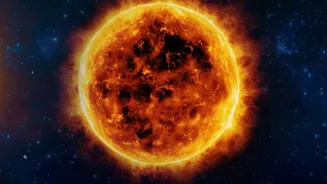
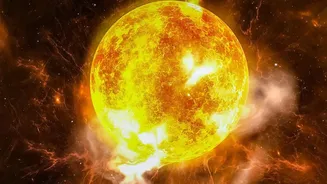
The sun has a heartbeat, a roughly 11-year cycle of activity that swings between quiet periods and stormy peaks. We are currently in Solar Cycle 25, which began in December 2019. This cycle is now approaching its most intense phase, known as the solar
maximum. While initial predictions suggested a weak cycle, solar activity has been much stronger than expected. Scientists at NASA and NOAA now anticipate this active period, characterized by an increase in sunspots and solar eruptions, to continue through 2026. A solar maximum isn't a single event but a prolonged plateau of high activity lasting for years, meaning the potential for disruption is not fleeting.
Solar Flares and CMEs
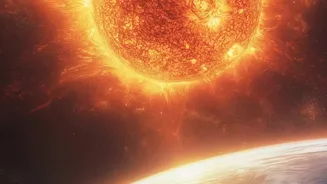
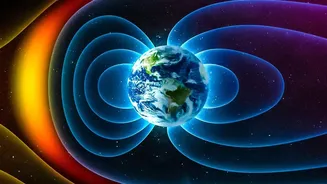
During solar maximum, the sun's surface crackles with energy. Two phenomena are particularly concerning for Earth-orbiting technology: solar flares and coronal mass ejections (CMEs). A solar flare is an enormous eruption of electromagnetic radiation, including X-rays and ultraviolet light, that travels at the speed of light. It can reach Earth in just over eight minutes, causing immediate effects on the sunlit side of our planet. CMEs are different; they are vast bubbles of charged particles and plasma from the sun's outer atmosphere, the corona. These travel more slowly, taking anywhere from 15 hours to a few days to reach Earth, but their impact can be significant, triggering what are known as geomagnetic storms.
The Ionosphere: Where Signals Go to Die
The primary reason satellite signals drop during solar events is the effect on Earth's ionosphere, a layer of our upper atmosphere filled with charged particles. This layer is crucial for some types of long-distance radio communication, but it can become a major obstacle for satellite signals. When the intense X-ray and UV radiation from a solar flare hits the ionosphere, it supercharges the D-region, its lowest and densest layer. This sudden increase in ionization causes high-frequency radio waves, like those used for GPS and other satellite communications, to be absorbed and degraded, leading to a radio blackout.
Scintillation and Signal Errors
Another major problem is a phenomenon called ionospheric scintillation. Imagine looking at a star twinkling in the night sky; the same effect can happen to satellite signals passing through a disturbed ionosphere. The turbulent, dense patches of electrons cause the signal's phase and strength to fluctuate rapidly. For a GPS receiver on the ground, this “twinkling” can make the signal unreadable, leading to a complete loss of lock or, more subtly, introducing significant positioning errors. During a strong geomagnetic storm, these errors can grow to tens of meters, rendering navigation systems unreliable.
Atmospheric Drag and Physical Damage
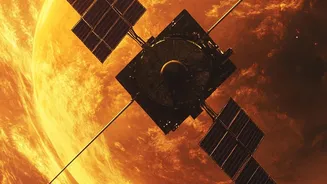
The impact isn't limited to signal interference. Geomagnetic storms heat Earth's upper atmosphere, causing it to expand. This increases the density of the air where low-Earth orbit (LEO) satellites operate. The resulting atmospheric drag slows satellites down, causing their orbits to decay faster than predicted. If not corrected, this can lead to premature re-entry, as famously happened to a batch of Starlink satellites in 2022. Furthermore, the high-energy particles released during a solar event can directly damage satellite hardware. They can flip bits in a satellite's memory, causing phantom commands, degrade solar panels, and even cause total satellite failure through electrical shorts.
Preparing for the Solar Storms
We can't stop the sun's temper tantrums, but we can prepare for them. Agencies like NOAA's Space Weather Prediction Center constantly monitor the sun, issuing forecasts and alerts. When a major event is predicted, satellite operators can put their spacecraft into a protective safe mode to minimize damage. Engineers are also developing more robust hardware, and some operators can even preemptively raise satellite altitudes to counter increased atmospheric drag. Having backup communication systems and integrity monitoring for GPS are other key strategies to mitigate the impact on critical services.