

Deeper Than Everest Is Tall
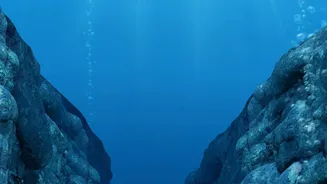
The Mariana Trench is a crescent-shaped scar in the Earth's crust located in the western Pacific Ocean. Its deepest point, the Challenger Deep, plunges to approximately 11,000 metres. To put that into perspective, if you were to place Mount Everest on
the seafloor at this point, its summit would still be covered by more than two kilometres of water. This incredible depth is the result of a geological process called subduction, where the massive Pacific tectonic plate is forced to dive beneath the smaller Philippine plate, creating a deep chasm. This process also makes the region one of the most geologically active on the planet, home to earthquakes and undersea volcanoes.
The Crushing Challenge of the Abyss
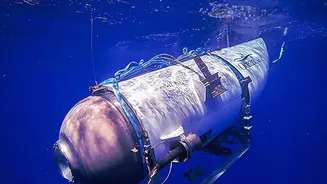
Exploring the Mariana Trench is an immense engineering challenge primarily due to the colossal hydrostatic pressure. At the bottom, the pressure exceeds 16,000 pounds per square inch (psi), which is over 1,000 times greater than at sea level. This is equivalent to having the weight of several dozen jumbo jets pressing down on a single person. This bone-crushing force can implode all but the most robustly designed submersibles. Added to this are the absolute darkness, as no sunlight can penetrate these depths, and near-freezing water temperatures that hover between 1 and 4 degrees Celsius. These factors make it one of the most inhospitable environments on Earth, testing the very limits of technology.
A Brief History of Daring Descents
Despite the dangers, human curiosity has driven a handful of expeditions into the abyss. The first-ever manned descent occurred in 1960 when Jacques Piccard and Don Walsh took the bathyscaphe 'Trieste' to the bottom, though their view was obscured by sediment. For over half a century, no one returned. Then, in 2012, filmmaker and National Geographic explorer James Cameron made a historic solo dive in his submersible, the 'Deepsea Challenger'. More recently, explorer Victor Vescovo has made multiple dives, further opening this frontier for research. These missions, while few, have been crucial in providing our first real glimpses into this unknown world.
Surprising Signs of Life
Far from being a barren void, the trench is home to a variety of unique lifeforms that have adapted to the extreme conditions. Scientists have discovered translucent Mariana snailfish, which are the deepest-living fish ever recorded, thriving at depths of around 8,000 metres. There are also shrimp-like crustaceans called amphipods, some of which are 'supergiants', and bizarre, giant single-celled organisms known as xenophyophores. These creatures survive not on sunlight, but on 'marine snow'—organic debris that drifts down from the upper ocean—and chemicals from the seafloor. The discovery of such a diverse ecosystem challenges our understanding of the limits of life.
An Uncharted Scientific Laboratory
The trench remains a frontier because there is still so much to learn. Scientists hope to study the unique geology of the subduction zone to better understand earthquakes and tsunamis. The extremophiles—organisms that thrive in these harsh conditions—could hold clues about the origins of life on Earth and the potential for life on other planets. However, exploration has also revealed unsettling truths. Scientists have found high concentrations of pollutants and even plastic bags at the bottom of the trench, a stark reminder of humanity's far-reaching impact. As technology improves, the focus is shifting from simply reaching the bottom to systematically mapping and studying the trench's vast, uncharted ecosystems, ensuring it remains a vital area for discovery.