
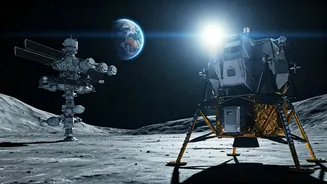




A New Race to the Moon
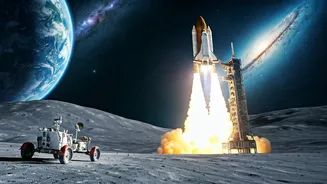
The Moon is once again the most coveted destination in the solar system, but the players and the goals have changed. While NASA’s Artemis II mission successfully sent four astronauts on a lunar flyby in April 2026, the focus now shifts to a fleet of robotic
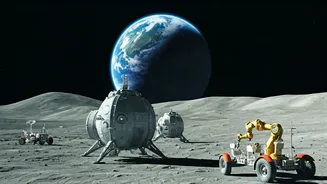
and commercial missions preparing the ground for a permanent human presence. China is a major player, with its Chang'e-7 mission scheduled to launch in August. This ambitious mission, comprising an orbiter, lander, rover, and a mini-flying probe, will explore the lunar south pole for water ice. This resource is considered crucial for future long-term settlements, as it can potentially be used for drinking water and producing rocket fuel. Numerous American commercial companies are also in the race, with landers from Blue Origin, Astrobotic Technology, and Intuitive Machines all targeting the Moon this year, aiming to build out the infrastructure needed for future human landings.
The Commercial Space Revolution
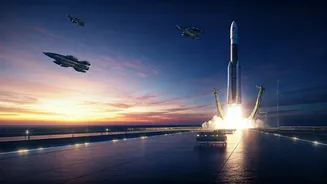
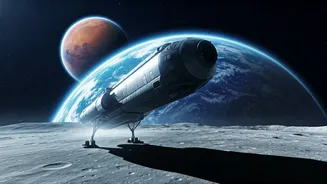
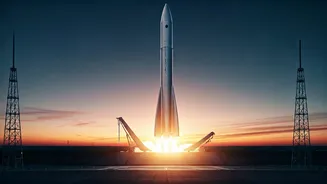
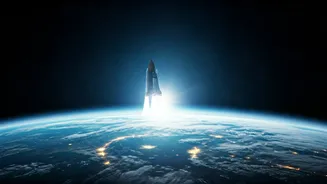
Perhaps the most significant shift is the rise of private industry. Companies like SpaceX are not just contractors; they are key drivers of innovation. 2026 is a critical year for SpaceX's Starship, the massive, fully reusable rocket designed to make deep-space travel economical. After a series of test flights, the company hopes to demonstrate crucial capabilities this year, including in-orbit refueling, which is essential for journeys to the Moon and Mars. While CEO Elon Musk has floated a "50/50 chance" of an uncrewed Starship launch to Mars during the launch window late this year, the more immediate goal is to prove the vehicle's reliability. Success would fundamentally alter the economics of space access. Beyond SpaceX, Vast Space aims to launch Haven-1, the first-ever commercial space station, while Sierra Space's Dream Chaser spaceplane is also slated for its first orbital flight, promising a gentler, runway-landing alternative for cargo return.
Beyond the Moon: Asteroids and Mars
While the Moon is the immediate focus, 2026 also features several missions looking deeper into the solar system. The Japanese Aerospace Exploration Agency (JAXA) is launching the Martian Moons Exploration (MMX) mission, which will attempt the first-ever landing on Mars's moon Phobos and return a sample to Earth. This could finally answer questions about whether the moons are captured asteroids or pieces of Mars itself. In another daring feat, China's Tianwen-2 probe will approach asteroid 2016HO3 for close observation and eventual sample collection. Meanwhile, Europe’s Hera spacecraft is set to arrive at the Didymos asteroid system in November. It will survey the crater left by NASA's DART impact in 2022, providing crucial data for planetary defense strategies. These missions highlight a growing global interest in asteroids for both scientific discovery and protecting Earth.
A Crowded, Competitive New Frontier
This flurry of activity signals a new geopolitical era in space. It's no longer a two-horse race; it's a crowded field with the US, China, Russia, Europe, Japan, and India all running ambitious programs. China, in particular, has demonstrated rapid progress, with plans for intensive missions in 2026, including multiple crewed flights to its expanding Tiangong space station and tests of reusable rockets. This rising competition, while creating strategic challenges, is also a powerful catalyst. It accelerates innovation, drives down costs, and pushes humanity's boundaries further and faster than ever before. With dozens of missions planned, from lunar landers to asteroid explorers and new commercial stations, the launches of 2026 aren't just isolated events; they are the foundational blocks of a new, multipolar, and economically driven future in space.