



Beyond Launch: A New Era of Intelligence in Orbit
For decades, the Indian Space Research Organisation (ISRO) has made the nation proud with its powerful rockets and successful missions to the Moon and Mars. Now, the focus is shifting from simply reaching space to mastering operations within it. This
strategic pivot involves equipping future satellites with two of the most disruptive technologies of our time: Artificial Intelligence (AI) and quantum mechanics. Experts at the recent National Space Technology Conclave 2026 emphasized that this combination will be transformative. The goal is to move beyond satellites that are mere collectors of data, entirely dependent on ground commands, to intelligent assets that can process information and make decisions right in orbit.
AI in Space: Satellites That Can Think and Act
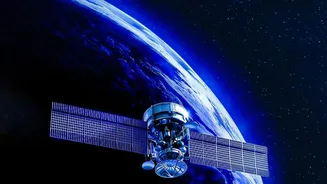
Imagine a satellite monitoring a flood-prone region. In the past, it would capture vast amounts of imagery and spend precious time sending it all back to Earth for analysis. By the time the data is processed, the window for effective action might have narrowed. With on-board AI, the satellite itself can analyze the data as it’s collected. It can identify the most critical areas, detect changes in water levels in real-time, and send back only the most urgent, actionable intelligence. This is made possible through 'edge computing' in space. ISRO has been developing AI and Machine Learning (ML) solutions for a range of applications, from spacecraft health monitoring and autonomous navigation to processing satellite data for weather forecasting, disaster prediction, and precision agriculture. This shift enables faster decision-making, not just for disaster management but also for urban planning and national security.
The Quantum Leap: Unhackable Communication
While AI gives satellites a brain, quantum technology provides them with an impenetrable shield. Standard encryption methods, which protect most of our digital world today, could become vulnerable to the immense power of future quantum computers. To counter this threat, India is investing heavily in Quantum Key Distribution (QKD), a method that uses the principles of quantum physics to create theoretically unbreakable encryption keys. A key component of India's ₹6,003 crore National Quantum Mission is the development of satellite-based secure quantum communication over thousands of kilometers. ISRO has already demonstrated this technology over a short distance and plans to launch a dedicated quantum communication satellite. This capability is crucial for protecting sensitive military, financial, and governmental communications from any possibility of cyber espionage.
A National Effort: ISRO, Startups, and Academia
This ambitious technological push is not happening in isolation. The Indian government has actively fostered an environment for private participation through policy reforms and initiatives like the National Quantum Mission. A vibrant ecosystem of space-tech and quantum startups is emerging to support the national goal. Companies like QNu Labs are focused on developing quantum-safe security networks, while others like QpiAI are building superconducting quantum computers. Even ambitious projects like placing a data centre in orbit are being explored by collaborations between AI startups like Sarvam and satellite company Pixxel. This synergy between ISRO's experience, the agility of private players, and the research prowess of academic institutions is creating a powerful engine for innovation.
Challenges on the Path to a Smarter Space Presence
The journey to a quantum and AI-powered satellite infrastructure is not without its hurdles. These are frontier technologies that require substantial investment, deep scientific expertise, and the development of highly specialized hardware, such as advanced cryogenic systems and precise laser technology. There is a global race to achieve dominance in these fields, and India must maintain its pace of innovation to keep up. Furthermore, building a skilled workforce capable of designing, building, and operating these complex systems is a long-term challenge that requires a concerted effort in education and training. Successfully overcoming these obstacles will be key to translating a bold vision into a tangible strategic advantage for the nation.