








The Brain's Great Mystery
Our brains are constantly changing. Every second, electrical signals fire between billions of neurons, forming the basis of our thoughts, feelings, and actions. Yet, amidst this constant activity, some connections remain remarkably stable, allowing us
to hold onto memories for a lifetime. Scientists have long understood that learning strengthens the connections between neurons, a process called synaptic plasticity. These connections, or synapses, often occur on tiny protrusions on brain cells called dendritic spines. The big question has been how these spines, which are themselves dynamic and can change shape, manage to create such enduring memories. A key part of the answer, it seems, lies in a structure that was hiding in plain sight.
A Skeleton Within the Cell
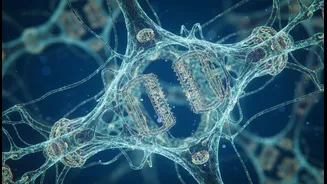
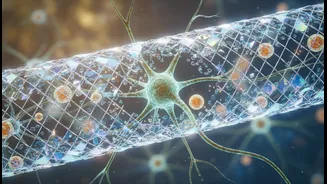
Researchers have recently identified a minuscule, lattice-like skeleton just beneath the surface of neurons. Known as the membrane-associated periodic skeleton (MPS), this internal framework is made of proteins, primarily actin and spectrin. Previously, scientists thought this structure was mostly passive, simply helping the neuron maintain its shape, much like the frame of a house. However, new studies using powerful super-resolution imaging have shown it plays a much more active and crucial role. This internal skeleton provides the physical support needed to stabilize the shape of dendritic spines after they are altered during learning. Think of it as a microscopic scaffolding that locks a new memory into place.
How the Scaffold Works
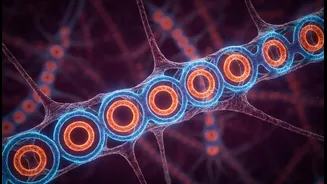
When we learn something new, specific synapses are activated. This activity triggers a remodeling of the actin cytoskeleton within the dendritic spine, changing its size and shape. This change is the physical hallmark of a new memory trace. The newly discovered role of the MPS is to preserve this new shape for the long term. The periodic structure, composed of rings of actin filaments linked by spectrin proteins, acts as a durable but adaptable backbone. It ensures that even though the molecules within the cell are constantly being replaced, the overall structure of the strengthened synapse remains intact, preserving the memory it encodes.
A 'Gatekeeper' for Brain Health
Beyond stabilizing memories, this cellular skeleton also acts as a 'gatekeeper', controlling what the neuron absorbs from its surroundings in a process called endocytosis. This is vital for neuronal health, allowing cells to take in nutrients and clear out waste. Research from Penn State has shown that the MPS puts the brakes on this process, preventing the cell from taking in too much material too quickly. Interestingly, the skeleton can be actively broken down to allow for more uptake when needed, creating a dynamic feedback loop. This gatekeeping function is critical, as a breakdown in this system could have serious consequences.
Implications for Alzheimer's and Beyond
This discovery has profound implications for understanding neurodegenerative diseases. In conditions like Alzheimer's disease, there is a progressive loss of dendritic spines and synaptic connections, leading to memory loss. Researchers found that when the MPS is weakened or disrupted, neurons can take up an excess of harmful proteins, such as the amyloid-beta fragments associated with Alzheimer's. This suggests that a deteriorating cellular skeleton could be an early step in the disease process. By understanding how this skeleton works, scientists hope to find new ways to protect it. Stabilizing the MPS could become a novel therapeutic strategy to slow or prevent the cellular damage that leads to cognitive decline, offering new hope in the fight against neurodegenerative disorders.