



Our Sun, The Unsolved Puzzle
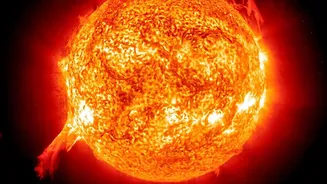
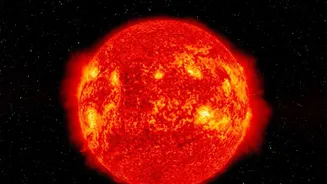
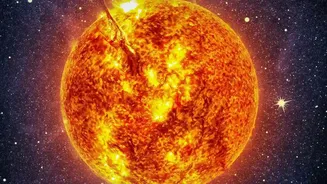
For all that we know about our solar system's star, some fundamental questions remain stubbornly unanswered. Chief among them is the coronal heating problem: why is the sun’s outer atmosphere, the corona, hundreds of times hotter than its visible surface?
The surface, or photosphere, simmers at around 5,500 degrees Celsius, but the corona reaches a staggering one million degrees or more. It’s a paradox that defies the simple logic that things get cooler as you move away from a heat source. Scientists have long theorised that some form of energy must be continuously transferred into the corona. Many suspect the answer lies in the complex dance of magnetic fields and waves of superheated gas, or plasma, that make up the sun. Unlocking this mystery is not just an academic exercise; it's key to understanding the solar wind and space weather that can impact our technology on Earth.
An Unexpected Discovery
Recently, solar physicists uncovered a truly puzzling phenomenon: a new class of solar wave that breaks all the rules. Dubbed high-frequency retrograde (HFR) vorticity waves, they appear as swirling patterns of plasma on the sun's surface. What makes them so strange is their speed and direction. These waves travel in the opposite direction to the sun's rotation, which is unusual but not unheard of. The real shock is that they move three times faster than current theories of solar hydrodynamics say is possible. Researchers from institutions including NYU Abu Dhabi and India's Tata Institute of Fundamental Research (TIFR) made the discovery by analysing over two decades of data from ground and space-based telescopes.
Waves That Defy Explanation
When scientists find something that doesn't fit, it's often more exciting than finding something that does. The team initially tested three leading theories to explain the HFR waves' incredible speed. They considered whether the sun’s powerful magnetic fields, its immense gravity, or the churning convection currents beneath the surface were giving these waves a boost. But none of these explanations fit the data. This means the HFR waves are not just a variation of a known process; they are likely the result of a completely new type of physics at play within our star. The existence of these mysterious waves provides a new, powerful tool to probe the sun’s interior, which cannot be observed directly. Like seismologists using earthquake waves to understand Earth’s core, solar physicists use these plasma waves to map the hidden depths of the sun.
New Clues for Old Mysteries
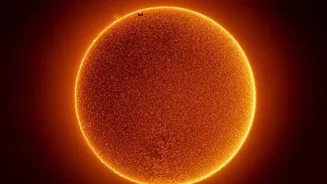
So what can these baffling waves tell us? Their existence forces a re-evaluation of how energy moves through the sun. While they don't provide a direct answer to the coronal heating problem yet, they hint that our models are missing a crucial ingredient. The mechanism that drives HFR waves might also be linked to the transport of energy that superheats the corona and accelerates the solar wind. The discovery is part of a wave of new solar science. Recent, ultra-high-resolution images from the Daniel K. Inouye Solar Telescope have also revealed tiny, swirling vortices on the sun’s surface for the first time, known as Kelvin-Helmholtz instabilities. These small-scale events could contribute to the overall heating of the atmosphere. Together, these findings are opening new avenues for research, suggesting that the answers may lie in a complex interplay of different types of waves and turbulence.
Why It Matters for India and the World
Understanding the sun’s behaviour has immediate practical consequences. The solar wind and violent solar flares can unleash powerful geomagnetic storms that threaten our satellites, GPS navigation, and power grids. For a nation like India, which is rapidly expanding its technological infrastructure and space presence, better space weather forecasting is a national priority. India's own solar observatory, Aditya-L1, is designed to study the sun's atmosphere and the very phenomena that discoveries like HFR waves seek to explain. By providing new data points and challenging existing theories, this global research effort, which includes Indian scientific collaboration, directly aids the mission of Aditya-L1. Ultimately, every new clue we gather about the sun helps us better protect our vital assets in space and on the ground.