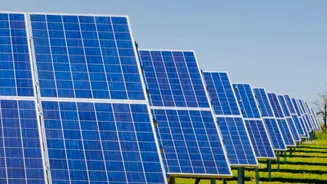








The Sun's Hidden Toll on Solar Power
Solar panels are built to live in the sun, but there's a catch. The very light that they convert into electricity also causes them to degrade over time. The primary culprit is ultraviolet (UV) radiation, an invisible part of the light spectrum. Just as
UV rays can damage human skin, they also break down the essential materials within a solar cell. This slow-motion damage, known as photodegradation, reduces a panel's efficiency and shortens its operational lifespan. Over years of exposure, the protective layers and a panel's internal components can yellow, become brittle, and lose their ability to effectively convert sunlight into power. Manufacturers currently use petroleum-based plastic films to shield panels, but these also degrade and present recycling challenges. This efficiency decline is a major hurdle in making solar energy a more cost-effective and durable long-term investment.
Nature's Ultimate Sunscreen: Melanin
It turns out nature has already perfected a solution. The key ingredient is melanin, the same pigment responsible for colour in human skin, hair, and the defensive ink cloud of a squid or cuttlefish. When a squid releases its ink, it's deploying a cloud of melanin nanoparticles. This pigment is an incredibly effective natural UV absorber. Its unique molecular structure is exceptionally good at absorbing a broad spectrum of light, especially harmful UV rays, and dissipating that energy as harmless heat. This is why melanin protects living organisms from sun damage. Scientists, in a field known as biomimicry, have looked to this natural superpower for inspiration, asking if the squid's defense mechanism could be repurposed to protect our technology.
From Cephalopod to Solar Cell
The transformation from dark ink to a high-tech shield is a fascinating multi-step process. First, the melanin must be sourced. It can be extracted and purified directly from the ink sacs of squid and cuttlefish, which are abundant byproducts of the fishing industry. Alternatively, researchers can create a synthetic version in the lab, often by polymerizing a chemical precursor like dopamine, to produce a material that is structurally very similar to natural melanin. Once the melanin is isolated, it is processed into a usable form. Researchers have developed several methods, including creating a solution that can be applied as an ultra-thin film using a simple drop-casting method. In other approaches, the melanin nanoparticles are mixed into a transparent medium, like a nanocellulose or aerogel, to create a durable, protective layer. This bio-synthetic film is then applied directly to the surface of the solar cell or its glass casing.
The Benefits of Bio-Protection
Adding a melanin shield offers several compelling advantages. The most significant is enhanced durability. By blocking UV radiation, the melanin layer protects the sensitive internal components of the solar cell, drastically slowing down degradation and extending the panel's effective lifespan. Some studies have shown that melanin can also improve performance. Its properties can help stabilize the solar cell's structure and, under certain conditions, even boost the generation of photocurrent. Furthermore, using a material derived from a natural, abundant biomass resource is a major environmental win. It provides a sustainable and potentially biodegradable alternative to the petroleum-based plastics currently used, reducing the carbon footprint and long-term waste associated with solar panel manufacturing.
Challenges and Future Horizons
While the science is promising, squid ink shields are not on every roof just yet. One of the main hurdles is scalability and cost-effectiveness. Researchers are working to refine extraction and synthesis processes to make melanin production viable on an industrial scale. Proving long-term stability in real-world weather conditions, from scorching heat to freezing cold, is another critical step. Early tests show excellent stability, with some melanin-based cells retaining 96% of their initial performance after 1000 hours of light exposure. The field is incredibly active, with studies exploring not just melanin from squid, but also from sources like onion skins and even fungi, all in the pursuit of a greener, more resilient future for solar energy. This research is part of a broader movement towards integrating biological solutions with technology, promising a new generation of more efficient and sustainable energy.