
The Cosmic 'Barcode' in Starlight
To understand how scientists study distant atmospheres, imagine starlight as a pure, white light containing all the colours of the rainbow. When this light passes through a gas, molecules in that gas absorb very specific colours, or wavelengths. Each
molecule, whether it's carbon dioxide or methane, has a unique absorption pattern, like a barcode. By capturing the remaining light and seeing which colours are missing, astronomers can identify exactly which chemicals are present in a planet's atmosphere. This fundamental technique is called spectroscopy.
Method 1: Analysing a Planet's Shadow
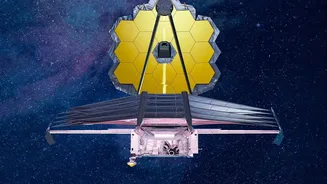
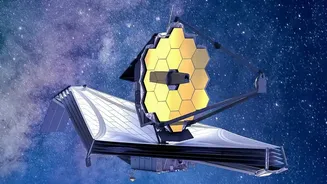
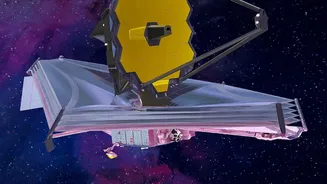
The most common method for this cosmic detective work is called transmission spectroscopy. It requires a specific alignment: an exoplanet must pass directly in front of its star from our point of view, an event known as a transit. As the planet transits, a tiny fraction of the starlight filters through its atmosphere. Telescopes like the James Webb Space Telescope (JWST) measure the star's light before the transit and then again as it passes through the planet's atmosphere. By subtracting one from the other, scientists are left with only the light that was altered by the atmosphere, revealing the chemical 'barcodes' of the gases within it.
Method 2: Capturing a Planet's Glow
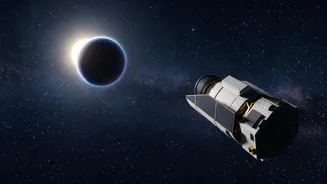
A second, complementary technique is emission spectroscopy. This method doesn't require a transit. Instead, telescopes measure the faint infrared light, or heat, that the planet itself emits. Scientists often do this during a 'secondary eclipse', when the planet passes behind its star. By measuring the total light from the star and planet together and then subtracting the light of just the star when the planet is hidden, they can isolate the planet's own thermal glow. This glow also contains spectral signatures that reveal atmospheric composition and temperature.
Why Carbon Dioxide and Methane?
Scientists are particularly interested in carbon dioxide and methane for several reasons. The presence of carbon dioxide is a strong indicator that a rocky planet has a significant atmosphere. It plays a crucial role in regulating a planet's climate, just as it does on Earth. Methane is even more tantalising. While it can be produced by geological processes like volcanic activity, it's also a waste product of life on Earth. On a planet with certain other atmospheric conditions, such as the presence of CO2 but very little carbon monoxide, a large amount of methane could be a compelling potential sign of biological activity, or a biosignature.
The Power of the Webb Telescope
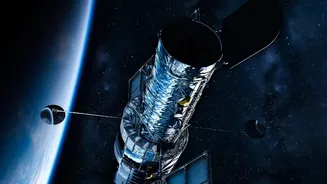
The James Webb Space Telescope has revolutionised this field. Its large mirror and advanced infrared instruments are exceptionally sensitive to the wavelengths absorbed by molecules like carbon dioxide and methane. Webb can perform both transmission and emission spectroscopy with unprecedented precision, allowing it to create detailed chemical profiles of exoplanet atmospheres. It has already successfully detected both carbon dioxide and methane in the atmospheres of multiple exoplanets, including the potentially habitable 'Hycean' world K2-18 b. These capabilities are moving astronomy from simply finding exoplanets to truly characterising them.